
Blog
Touchpoint Analysis and Conversion Funnel Analysis in B2B SaaS Revenue Operations
Touchpoint analysis shows which buyer interactions move B2B SaaS deals forward. Pair it with conversion funnel analysis to get past last-touch bias.
UTM tagging explained for B2B SaaS: the five parameters, a naming structure for paid campaigns, and the three points where UTM data is lost before the CRM.
 Ishan ManchandaNov 5, 2026
Touchpoint analysis shows which buyer interactions move B2B SaaS deals forward. Pair it with conversion funnel analysis to get past last-touch bias.

78% of form fills never become SQLs. The shared metrics - cost per SQL, MQL-to-SQL by channel, pipeline coverage - a RevOps dashboard must show both teams.
Last-touch attribution gives 100% of deal credit to the final touchpoint. Learn what it is, how it works, and why it distorts budget decisions in B2B SaaS.
Request a quote and our experts will contact you within 24 hours with tailored solutions and pricing.
Last updated: Nov 5, 2026
By the Editorial Team | Last updated: November 4, 2026
UTM tagging is the practice of appending tracking parameters to a URL so each click carries its source, medium and campaign into analytics and the customer relationship management (CRM) record. For B2B SaaS teams, that label is the first link between an ad click and a closed-won deal. It is also the first link to snap: only 18% of B2B marketers track activity to closed revenue with a complete attribution model (Anteriad, 2026). This guide defines each parameter, shows a naming structure for paid campaigns, and explains the three places where tags disappear before the form submit. It sits inside the wider topic of marketing attribution models.
Key Takeaways
- UTM tagging uses five parameters (source, medium, campaign, content, term) to label every paid click with where it came from.
- Inconsistent UTM values, such as "LinkedIn" in one link and "linkedin" in another, split one channel into several rows in reports and CRM fields.
- UTM parameters are lost at three points before the form submit: page navigation, redirects and in-app browsers, and CRM or hidden-field overwrites.
- A UTM naming structure works when each parameter draws from an approved lowercase list owned by one person.
- A test click and a test form submission show within minutes whether UTM data reaches the CRM.
UTM tagging is the practice of adding tracking parameters to a link so analytics tools and the CRM can record which source, medium and campaign sent each visitor. It matters for campaign reporting because only 18% of B2B marketers track activity all the way to closed revenue with a complete attribution model (Anteriad, 2026).

Without tags, a paid click often lands in analytics as "direct" or "unassigned". The ad platform then reports conversions that the CRM cannot match to any source. That gap is why finance questions whether marketing spend produces pipeline.
The 2026 Anteriad survey covered 631 marketing decision-makers, fielded in March 2026 by Ascend2. Marketers Anteriad labels "Data Heroes" report full visibility into attributing marketing activity to closed revenue at 74%, against 51% for others (Anteriad, 2026). They also significantly exceed goals at 43%, against 18% for others (Anteriad via GlobeNewswire, 2026). Anteriad is a B2B data vendor, and the segment label is its own, so these figures show correlation, not proof that tagging alone drives results.
The cost of weak data is stated plainly in a 2025 industry release: "poor data quality slows down pipeline velocity, erodes trust, and puts organizations at risk." (Integrate press release, 2025)
A UTM parameter is a key-value pair added to the end of a URL, such as utm_source=linkedin, that labels where a click came from. Five exist: utm_source, utm_medium, utm_campaign, utm_content and utm_term. Forms can copy them into hidden fields so the CRM stores them, yet 48% of surveyed B2B marketers report data quality and reliability problems (Anteriad, 2026).

The table below shows what each parameter answers and an example value for B2B SaaS paid campaigns.
| Parameter | Question it answers | Example value | Typical status |
|---|---|---|---|
| utm_source | Which platform or site sent the click? | Required | |
| utm_medium | Which type of traffic is it? | paid-social | Required |
| utm_campaign | Which campaign or initiative? | 2026q4-demo-request | Required |
| utm_content | Which ad or creative variant? | case-study-video | Optional |
| utm_term | Which keyword or audience? | revenue-operations | Optional |
The path has five links. An advertiser sets the tags on the ad. The visitor lands on a page whose URL carries them. Analytics records them. A script copies them into a hidden field, which is a form field the visitor does not see, and the form submit writes them to CRM properties. Any break in that chain leaves the CRM source field blank. The deeper account of that breakage is in how ad click tracking breaks between the ad platform and the CRM.
A UTM link is a normal destination URL with UTM parameters appended after a question mark and joined by ampersands. Consistent structure means lowercase values, one approved list per parameter and one owner for that list. Without it, 76% of CRM users say less than half of their organization's CRM data is accurate and complete (Validity, 2025).

A full UTM link looks like this: https://example.com/demo?utm_source=linkedin&utm_medium=paid-social&utm_campaign=2026q4-demo-request&utm_content=case-study-video
Six rules keep the data clean:
The matrix below is a starting dictionary for common B2B SaaS paid channels. Pick one medium value per channel type and keep it. The choice between "paid-social" and "paid_social" matters less than using the same one everywhere.
| Channel | utm_source | utm_medium | Example utm_campaign | Note |
|---|---|---|---|---|
| LinkedIn Ads | paid-social | 2026q4-demo-request | Set at account, campaign or ad level | |
| Google Ads (search) | cpc | 2026q4-brand-defense | Matches paid search channel grouping | |
| Meta Ads | meta | paid-social | 2026q4-retargeting | Same medium as other paid social |
| Reddit or X Ads | paid-social | 2026q4-devtools-awareness | Source names the platform | |
| Review-site listings | g2 | paid-listing | 2026q4-category-leads | Name the site in source |
| ABM display | programmatic | display | 2026q4-abm-tier1 | Audience goes in utm_term |
As of September 2026, LinkedIn Campaign Manager supports URL parameters at account, campaign and ad level, with dynamic macros at account and campaign level, and it does not write utm_ parameters for you (Terminus, 2026). Dynamic UTMs apply only to the main destination URL and do not work for Thought Leader Ads or boosted company posts (B2Linked, 2025). LinkedIn's API documentation is direct on one point: "You must ensure uniqueness of the dynamic UTM parameters" (Microsoft Learn, 2025).
UTM parameters are lost at three points before a form submit: the visitor moves to another page and the URL no longer carries them, a redirect or in-app browser drops the query string, or a hidden field or CRM rule overwrites first-touch values on a later visit. Lack of high-quality data is the top challenge for 53% of UK B2B marketers (Anteriad, 2026).

That UK figure compares with 43% for US marketers in the same 2026 study, which draws on 221 UK respondents from the 631-person global survey.
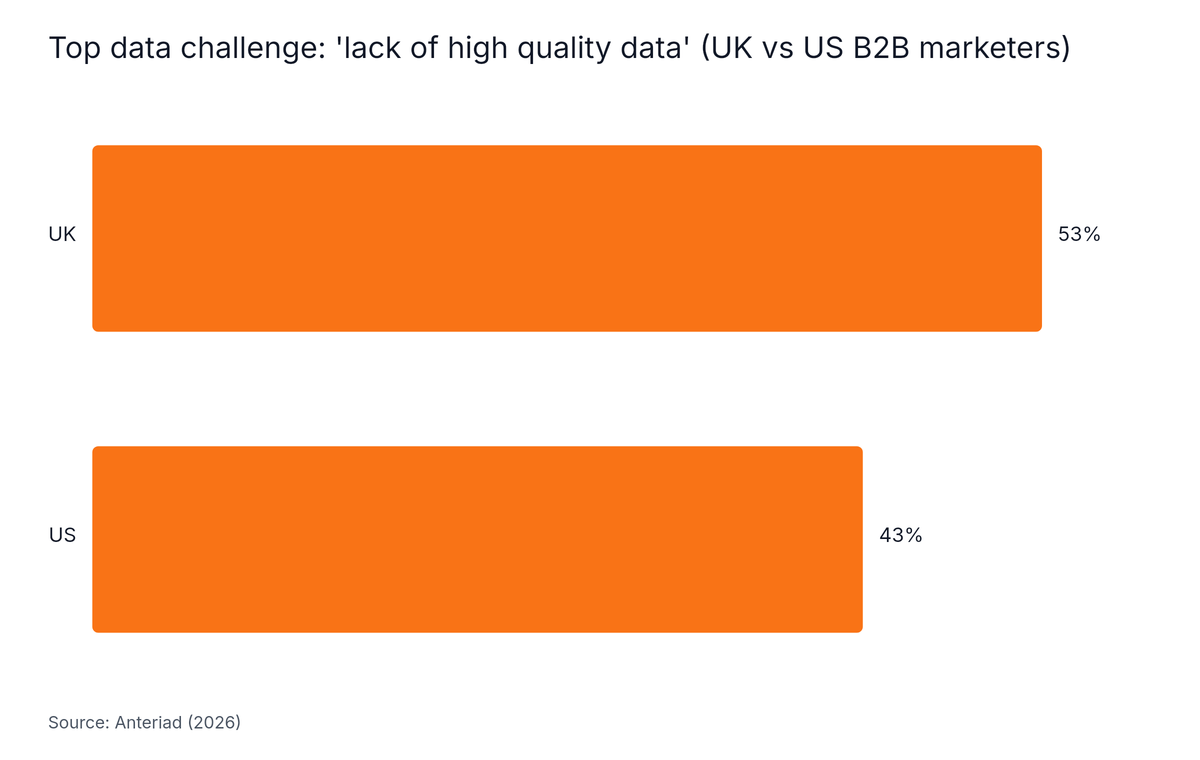
Source: Anteriad, 2026
UTM parameters are lost at the first point when the visitor navigates to another page. The tags live only in the landing page URL. A visitor who reads the pricing page and then the product page has left the tagged URL, so a form on the third page sees no parameters. The fix is to store the values in first-party storage on landing, then fill hidden fields from storage rather than from the current URL. An October 2026 practitioner write-up from Leadfeeder (2026) describes the same approach.
UTM parameters are lost at the second point when a redirect, shortener or in-app browser drops the query string. Link shorteners, redirect rules, email gateways, CDN rules, iframes and some in-app browsers can all erase the tags. Test every tagged URL by clicking it and reading the final landing URL.
Safari adds a second concern. WebKit's documentation for Safari 26 describes a protection that "prevents known fingerprinting scripts from reading state that could be used for navigational tracking, such as query parameters and document.referrer" (WebKit, via Improvado, 2026). Vendor reports conflict on how far Link Tracking Protection reaches. A late-October 2026 review reports it stays on in Mail, Messages and Private Browsing, and covers normal tabs only if the user selects All Browsing (SignalBridge, 2026). The pattern most sources agree on is summarized below.
| Parameter type | Examples | Reported Safari behavior |
|---|---|---|
| Standard UTM parameters | utm_source, utm_medium | Generally reported as surviving |
| Ad-platform click IDs | gclid, fbclid, msclkid | At risk of being stripped |
| Scripts reading query strings | Known fingerprinting scripts | Blocked from reading by Safari 26 |
Because sources disagree, a test click in Safari is the only reliable answer for a given setup.
UTM parameters are lost at the third point when a hidden field or CRM rule overwrites the first-touch value. A first-touch field is a CRM property that stores the source of the first visit and should never change. A latest-touch field updates on each visit. When one field serves both jobs, a repeat visit with no tags, or a form that submits blank hidden values, replaces a good source with "direct" or nothing. Protect first-touch properties from overwrite, and normalize case to lowercase at ingest.
One further conflict sits in Google Ads. With auto-tagging on, a Google click ID (GCLID) is a unique identifier appended to each landing URL. If UTM parameters are also present and the GCLID cannot be used, Google Analytics derives all traffic-source values from the UTMs only. Keep the account-level and campaign-level URL suffixes identical, or two sets of labels will compete.
To check that UTM data reached the CRM, click a tagged link in a clean browser, browse two pages, submit a test form and confirm the source, medium and campaign fields on the new record. Checking matters because 76% of CRM users say less than half of their CRM data is accurate and complete (Validity, 2025).

Run a monthly audit: list the distinct utm_medium values, the share of traffic labeled direct, and the count of blank CRM source fields. Fix the cause in the link builder. Leave raw historical data unchanged and clean it in reporting.
UTM tagging does not fix last-touch bias, consent gaps or poor data quality. It is a labeling system, not an attribution model. In the 2025 Validity survey, 37% of CRM users reported losing revenue as a direct consequence of poor data quality (Validity, 2025), a problem no tag format alone removes.
Our data: 91% of 104 audited Google Ads accounts had no Google click ID reaching the CRM (The 2026 B2B SaaS Google Ads Waste Report, GrowthSpree, 2026; $78.0M in spend). After a 90-day attribution fix, the share of closed-won deals traced to a campaign went from 0% to 67%. The fix covered click ID storage and attribution setup, not UTM naming alone.
Three limits are worth stating:
This guide is not for B2C or e-commerce teams, or for companies with no sales team and no CRM yet. Teams weighing tools for this work can read about marketing attribution software for B2B SaaS.
A UTM parameter is a key-value pair added to a URL, such as utm_source=linkedin, that labels where a click came from. Analytics tools read it from the landing page URL, and forms can copy it into hidden fields so the CRM stores the source with each lead.
UTM links are destination URLs with UTM parameters appended after a question mark. For consistent tracking, use lowercase values only, draw each value from an approved list, keep one naming pattern for utm_campaign, and give one person ownership of the list. Consistency matters more than which pattern is chosen.
Standard utm_ parameters are generally reported as surviving in Safari, while click IDs such as gclid, fbclid and msclkid are the parameters at risk. Vendor reports conflict on how far Safari's Link Tracking Protection reaches, so the reliable check is to click a tagged link in Safari and inspect the landing URL.
UTM values are treated as different strings when the capitalization differs, so LinkedIn and linkedin can appear as two separate sources in reports. The fix is a lowercase-only rule, enforced by a link builder or a validation step before any tagged link goes live.
UTM parameters should not be used on internal links. A tagged internal link can start a new session and overwrite the real source of the visit, so a paid click appears as site-internal traffic. Use UTMs only on links that bring visitors to the site from outside.
UTM parameters still matter with Google Ads auto-tagging on, because they carry labels the click ID does not. If UTMs are present and the GCLID cannot be used, Google Analytics derives all traffic-source values from the UTMs only, so keep account-level and campaign-level URL suffixes identical.
UTM fields are blank in the CRM when tags are lost before the form submit: the visitor browsed to a page without them, a redirect or in-app browser dropped the query string, or a hidden field submitted empty values. Store the values on landing, then fill hidden fields from storage.
The utm_medium for LinkedIn Ads is paid-social in the dictionary used here, with utm_source set to linkedin. The exact spelling matters less than using one value everywhere. Choose paid-social or paid_social once, document it, and apply it to every paid social platform.
UTM tagging works when the labels are consistent, survive the visit and land in a protected CRM field. The main points:
Once the data lands, a shared marketing and sales reporting dashboard can show both teams the same source numbers. For help applying this to a specific CRM and ad account, Meet with an expert for a free consultation. Bring the funnel or reporting question, and brainstorm the next step.
Written by
Ishan Manchanda
Ishan Manchanda is co-founder of GrowthSpree, a B2B SaaS marketing consultancy founded in 2017 that has managed $60M+ in ad spend across 300+ B2B SaaS companies. He focuses on demand generation, go-to-market strategy and pipeline growth, and has been featured in Silicon Valley Times, SaaS Mag and the Unbounce podcast.
© 2026 RevOps for B2B SaaS All rights reserved.