revenue operations vs sales operationsRevOps vs sales opsdo we need RevOps or a sales ops hire
Revenue Operations vs Sales Operations: Where the Responsibilities Differ
Revenue operations vs sales operations: who owns CRM hygiene, territory, quota, stage definitions and reporting, plus triggers for the Series A hire.
Ishan ManchandaNov 8, 2026
Last updated: Nov 8, 2026
Revenue Operations vs Sales Operations: Where the Responsibilities Differ
Revenue operations (RevOps) differs from sales operations in scope: sales operations supports the sales team with customer relationship management (CRM) hygiene, territory and quota, while RevOps spans marketing, sales and customer success. In B2B SaaS the question arrives early: do we need RevOps or just a sales ops hire at Series A? The answer depends on who owns the shared stage definitions and reporting layer. Adoption shows the window: 41% of companies under $5M in annual recurring revenue (ARR) have a dedicated RevOps function, versus 74% at $5M to $20M (, 2026, vendor survey). This page draws the boundary line by line and ends with a trigger-based guide to which role fits which stage. For the build-versus-buy angle, see .
Sales ops serves the sales team (CRM hygiene, territory, quota); RevOps serves marketing, sales and customer success.
RevOps owns the shared stage definitions and the reporting layer that every team reads from.
Cross-team number disputes, forecast misses and untraceable ad spend are the triggers that justify RevOps over a sales ops hire.
Reporting lines and org models change what RevOps can do, so settle them before the first hire.
What is the difference between revenue operations and sales operations?
Sales operations (sales ops) is the function that supports the sales team with CRM hygiene, territory design, quota setting and sales reporting. Revenue operations spans marketing, sales and customer success and owns the shared stage definitions and reporting layer all three use. As of 2026, 78% of surveyed B2B companies report a dedicated RevOps function (SyncGTM, 2026, vendor survey).
A small green ceramic ring resting inside a larger pale ring on a clean tabletop
The table splits the work by responsibility. Marketing ops sits beside both: it manages campaign infrastructure, lead scoring and attribution.
Owns the single layer used by marketing, sales and CS
Forecast process
Runs the sales forecast call
Owns commit criteria and accuracy tracking
Attribution and lead routing
Uses the output
Owns the rules across channels
Customer success and renewal data
Not in scope
In scope
The pattern: sales ops optimizes one team, while RevOps maintains the shared system between teams. A reporting layer is the single set of reports that marketing, sales and customer success all read from.
Who owns the MQL, SQL and opportunity stage definitions?
RevOps owns the shared MQL, SQL and opportunity stage definitions, because those definitions cut across marketing, sales and customer success. Stage definitions are written entry criteria that say what must be true before a record moves into each lifecycle stage. Sales ops contributes the sales-side criteria, but a single team owning them alone is how two reports end up disagreeing.
Three blank index cards with colored tabs laid in a row on a clean table
A marketing-qualified lead (MQL) is a lead that meets a defined score or firmographic threshold. A sales-qualified lead (SQL) is a lead that sales has accepted against written criteria. Without one written version, the two teams count different things.
Published data: 78% of form fills in 104 audited Google Ads accounts never became a sales-qualified lead (GrowthSpree, June 2026, $78.0M in spend). When form fills count as leads, marketing's number and sales' number will not match.
How much do conversion rates depend on the definition?
Conversion benchmarks vary by how stages are defined. One benchmark across 50+ clients shows MQL to SQL rates of 26% for paid search, 30% for LinkedIn and 51% for SEO (First Page Sage, updated June 2025). A separate median for B2B SaaS Google Ads is 13% to 18% (GrowthSpree, April 2026). The two sources define stages separately, so they should not be averaged.
Shared definitions also relate to growth. Gartner's survey of 227 chief sales officers found that sales organizations that collaborate on enablement content with marketing and service are 2.4x more likely to achieve strong commercial growth (Gartner, 2026). That finding covers enablement, not stage definitions directly, so treat it as supporting context. For what shared reports should contain, see the RevOps reporting dashboard guide and the overview of attribution models.
Why does the data layer matter for AI?
The same definition layer feeds AI tools. In a May 2026 survey of 123 RevOps practitioners, 73% reported an AI mandate but only 38% had the data to support it (Revenue Wizards, 2026). The sample is small, so read it as a signal, not a benchmark. Sales ops keeps records clean for sellers; RevOps defines what each field and stage means across teams. For the tooling side, see the revenue operations software guide.
Do we need RevOps or just a sales ops hire at Series A?
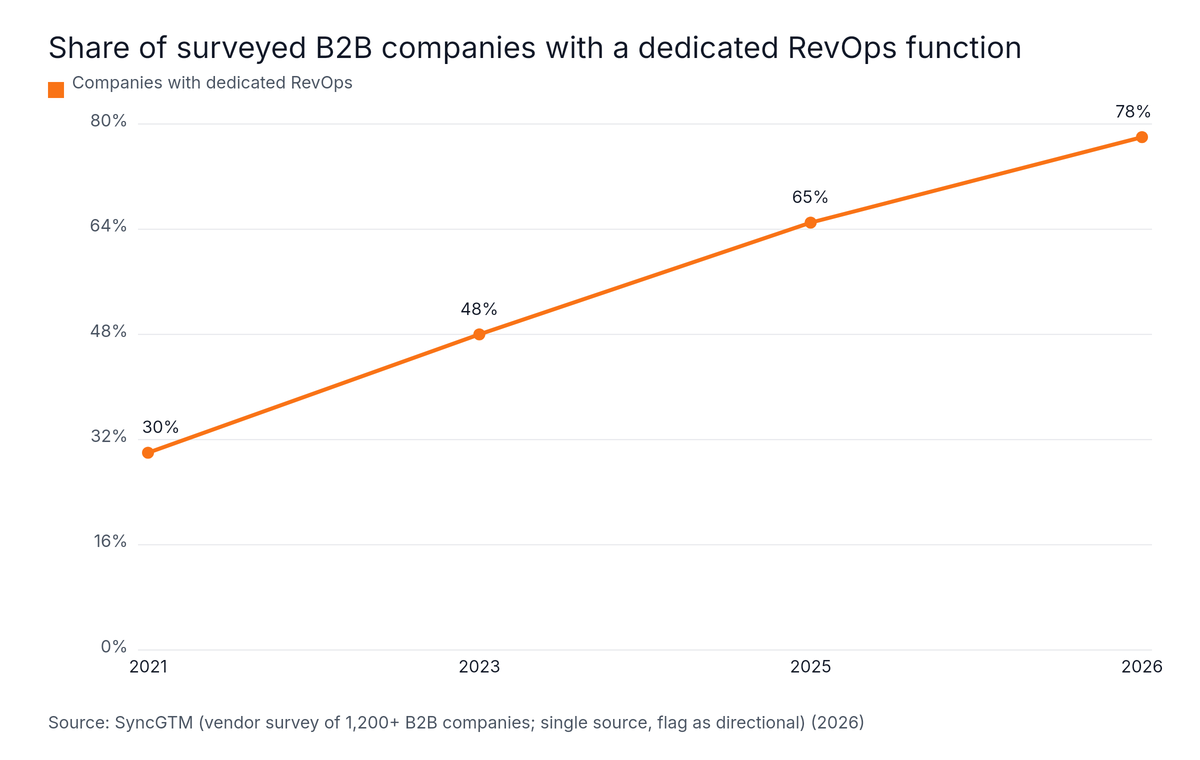
A B2B SaaS company needs RevOps rather than only a sales ops hire once problems cross team lines: marketing and sales report different numbers, forecasts miss, or ad spend cannot be tied to revenue. Adoption follows this: 41% of companies under $5M ARR have a dedicated RevOps function, versus 74% at $5M to $20M (SyncGTM, 2026).
The chart shows the wider trend in the same vendor survey of 1,200+ B2B companies, which puts the 2026 share at 78%. Other sources report lower adoption, so read the line as directional.
Line chart: Share of surveyed B2B companies with a dedicated RevOps function. Highest: 2026 at 78%.
Advice at Series A is split. Some vendor and agency sources say sales ops alone is enough for a small team with one sales motion. Others say hire RevOps leadership at Series A. Triggers settle the argument better than headcount rules:
Trigger
Sales ops hire is enough
RevOps is needed
The problem sits inside sales (CRM clean-up, territories, quota)
Yes
Not yet
Marketing and sales report different numbers for the same quarter
No
Yes
A missed forecast or a board asking for pipeline coverage
Partly
Yes, if the cause is stage definitions
Ad spend grows and nobody can tie it to closed-won revenue
No
Yes
Customer success needs the same stage model as sales
No
Yes
A CRM rebuild after funding
Partly
Yes, if several teams use the CRM
Forecast misses show the cost of waiting. A published range with no stated source, sample or method puts median commit forecast accuracy at 85%, best-case accuracy at 38% and weighted pipeline accuracy at 22% (2026, unsampled range). Treat these as labeled ranges, not findings. To weigh a hire against outside help, read the comparison of internal and external options linked in the introduction.
Where does RevOps report, and how do sales ops and RevOps fit together?
RevOps reporting lines vary, but about 30.4% of revenue operations professionals report to the Chief Revenue Officer (Revenue Operations Alliance, 2025, method not stated). Three org models are common: sales ops stays a separate team, sales ops folds into RevOps, or RevOps sits above existing sales ops and marketing ops teams. Each fits a different stage.
Three wooden building blocks arranged in three different stacking patterns on a pale surface
Org model
How it works
Best fit
Sales ops stays separate
Sales ops serves sales; a separate owner handles shared definitions
Early stage, one motion, problems limited to sales
Sales ops folds into RevOps
One team covers sales ops tasks plus shared definitions and reporting
Series A to Series B, one RevOps lead with analyst support
RevOps above sales ops and marketing ops
Specialist ops teams report into one RevOps head
Larger teams with several motions
The reporting line carries political risk. When RevOps sits under sales leadership, it can drift into sales-only work, and marketing may build its own reporting. Place the function where it can hold shared definitions for all teams, and write that charter down.
Which role fits which stage?
Choose the role by trigger, not by title: hire sales ops when the pain sits inside the sales team, and hire RevOps when problems cross marketing, sales and customer success. The stakes are data quality, since Validity's 2026 report found 62% of organizations report lost revenue from poor CRM data (Validity, 2026).
A plain wooden signpost with two blank arrows pointing in different directions
Company situation
Typical trigger
Role that fits
Seed, one sales motion, spreadsheets or a basic CRM
Messy CRM records, unclear territories
Sales ops hire, or a founder-led setup
Series A, marketing and sales both report numbers
Two dashboards for the same quarter
First RevOps hire who owns stage definitions
Series A to Series B, funding closed, revenue plan due
Missed forecast, board asks for pipeline coverage
RevOps lead with sales ops folded in
Series B and later, several motions and customer success
Separate ops teams with conflicting data
RevOps head above specialist ops teams
Only 21% of marketers say their CRM data is very well prepared for AI (Validity, 2026), so the shared data layer is worth fixing before more tooling is added.
Who is this comparison not for?
The revenue operations vs sales operations comparison is not for companies with no sales team and no CRM yet, nor for B2C, DTC or e-commerce operations. It also leans on vendor surveys, such as SyncGTM's 2026 survey of 1,200+ B2B companies (SyncGTM, 2026), so adoption figures are directional, not precise.
Three further limits apply:
Vendor data: the SyncGTM and Revenue Wizards figures come from vendor and consultancy surveys. Other sources report lower RevOps adoption.
Unsampled ranges: the forecast accuracy figures are published ranges with no stated source, sample or method.
No fixed threshold: no verified source sets a rep count or ARR level at which RevOps becomes mandatory. The triggers are decision aids, not rules.
Frequently Asked Questions
RevOps vs sales ops vs marketing ops: what is the difference?
Sales ops supports the sales team with CRM hygiene, territory design and quota setting. Marketing ops manages campaign infrastructure, lead scoring and attribution. RevOps spans both and adds customer success, owning the full funnel from first touch to renewal plus the single stage model and reporting layer that every team uses.
Is revenue operations the same as sales operations?
No. Sales operations serves the sales team only, covering CRM hygiene, territory and quota. Revenue operations covers marketing, sales and customer success, and owns the shared stage definitions and reporting layer. Some companies rename sales ops as RevOps without widening the scope, which keeps the original sales-only function under a new title.
Does RevOps replace sales ops?
Not always. Three models exist: sales ops stays a separate team, sales ops folds into RevOps, or RevOps sits above existing sales ops and marketing ops teams. Many B2B SaaS companies keep sales ops tasks such as territory and quota admin inside RevOps once the function exists, while a few keep both.
When should a SaaS company hire its first RevOps person?
Most B2B SaaS companies hire their first RevOps person around Series A, when marketing and sales report different numbers for the same pipeline or a CRM rebuild is needed. The trigger is usually a missed forecast, a funding round, or the point where spreadsheets can no longer track the funnel.
Who should RevOps report to?
No single reporting line is standard. About 30.4% of revenue operations professionals report to the Chief Revenue Officer, according to the Revenue Operations Alliance (2025, method not stated). The line matters because RevOps serves marketing, sales and customer success, and reporting to one of them can narrow its scope.
Conclusion
Sales ops and RevOps differ in scope, and the Series A choice follows the triggers rather than the job title. Five takeaways:
Hire sales ops when the pain is inside sales: CRM clean-up, territories and quota.
Hire RevOps when marketing and sales disagree on numbers, forecasts miss or ad spend cannot be traced to closed-won.
Give RevOps ownership of stage definitions and publish one written version.
Choose the org model and reporting line before the first hire.
Treat adoption and benchmark figures as directional, since most come from vendor surveys.
One funnel. One set of definitions. One number everyone trusts. To test these triggers against your own funnel, CRM or reporting question, Meet with an expert for a free consultation.
Written by
Ishan Manchanda
Ishan Manchanda is co-founder of GrowthSpree, a B2B SaaS marketing consultancy founded in 2017 that has managed $60M+ in ad spend across 300+ B2B SaaS companies. He focuses on demand generation, go-to-market strategy and pipeline growth, and has been featured in Silicon Valley Times, SaaS Mag and the Unbounce podcast.
 Ishan Manchanda