Request a quote and our experts will contact you within 24 hours with tailored solutions and pricing.
Revenue Operations Tech Stack: What Belongs at Each Stage of B2B SaaS Growth
A revenue operations (RevOps) tech stack is the set of connected tools that carries a B2B SaaS lead from first touch to closed-won, and early on it needs only a clean customer relationship management (CRM) system. The hard part is order. Teams leaving spreadsheets, or rebuilding after Series A, are told to buy every category at once. This guide sorts the revenue operations tech stack by stage, names what to defer, and shows what one person can run alone. For a wider view of categories, see this overview of revenue operations software.
Key Takeaways
A B2B SaaS revenue operations tech stack should be built in layers: CRM core, routing, enrichment, attribution, then forecasting.
76% of CRM users say less than half of their CRM data is accurate and complete (Validity, 2025), so data quality comes before any added tool.
Native CRM rules handle early lead routing; a dedicated routing tool pays off when response speed becomes the bottleneck.
One RevOps person can run configured tools without an engineer, but custom code and warehouse-based attribution need engineering help.
47% of RevOps professionals rate their stack's ROI as average or worse (MarketingOps.com, 2025), which favors buying by stage.
What should a revenue operations tech stack include at each stage?
A B2B SaaS revenue operations tech stack should grow in layers: a clean CRM core first, then lead routing, then enrichment, then attribution, then forecasting tools. Teams that buy everything at once pay for it. In a 2025 survey, 47% of RevOps professionals rated their stack's ROI as average or worse (MarketingOps.com, 2025).
A staircase of four wooden blocks, each larger than the last, on a clean desk
The survey covered 250+ professionals across revenue, marketing and operations roles. It supports a simple rule: buy for the stage you are in, not the stage you hope to reach. The table below sorts each layer by stage. It names categories only, because the right product depends on team size and sales motion.
Stage
Add now
Defer
Who runs it
Spreadsheets to first CRM
CRM core, written stage definitions, deduplicated import
Why does the CRM core come before every other layer?
The CRM core is the customer relationship management system that stores every lead, account, deal and stage definition, and every other layer reads from it. Data quality decides whether it works: 76% of CRM users say less than half of their organization's CRM data is accurate and complete (Validity, 2025).
A small card file box with neatly aligned, labelled cards
The same survey of 602 CRM users in the U.S., U.K. and Australia found that 37% of organizations lose revenue as a direct result of data quality (Validity, 2025). Respondents also report spending 13 hours per week hunting for basic information in the CRM, a self-reported average.
Validity's SVP of Marketing summed up the problem: "There's a growing gap between confidence and reality when it comes to data quality" (Validity, PR Newswire, 2025). The same executive added: "Leaders need to step in early to align teams and set clear expectations for data management." (Validity, MarTech Cube, 2025)
How should a spreadsheet-to-CRM move be sequenced?
Migration order matters. Fix the definitions before the import, not after. A lifecycle stage is the label on a CRM record that shows where a lead sits in the funnel, such as marketing-qualified lead (MQL) or sales-qualified lead (SQL).
Write one stage model with an entry criterion for each lifecycle stage, tied to a buyer action.
Deduplicate the spreadsheet by company and contact.
Standardize the fields every later layer will read: source, owner, stage and date.
Add a field for the Google click ID (GCLID), the parameter that traces a lead to an ad click.
Import, then check a sample of records against the original.
When do you need a dedicated lead routing tool instead of native CRM rules?
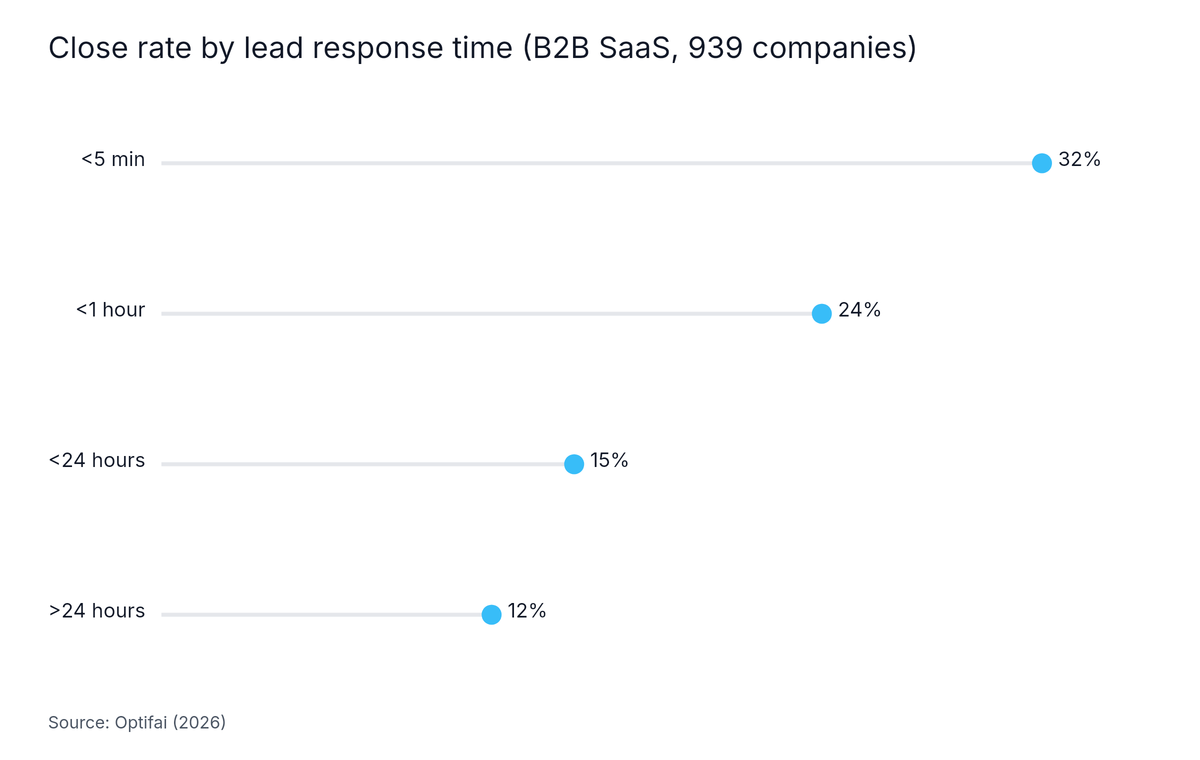
Lead routing is the rule set that assigns each inbound lead to an owner and alerts them. Native CRM assignment rules are enough while one or two people take every lead. A dedicated tool earns its place when speed matters: a 2026 benchmark of 939 B2B SaaS companies found a 32% close rate under 5 minutes versus 12% at 24+ hours (Optifai, 2026).
A railway switch directing a track to one of two branches
The benchmark is a single-vendor source and shows correlation, not proof that speed alone causes closes. The same data puts the close rate at 24% inside one hour and 15% inside 24 hours (Optifai, 2026). The direction is consistent, and it is the business case for automating assignment.
Lollipop chart: Close rate by lead response time (B2B SaaS, 939 companies). Highest: <5 min at 32%.
When do enrichment, attribution and forecasting tools earn a place?
Enrichment, attribution and forecasting tools earn a place when a named problem appears that clean CRM data cannot solve. Enrichment fills missing fields, attribution ties spend to closed-won revenue, and forecasting tools score pipeline risk. Only 16% of respondents say their RevOps tech gives strong, data-driven insight (MarketingOps.com, 2025), so buy to solve a problem, not to own a category.
Three nested translucent boxes on a table showing layers inside one another
Enrichment is the process of filling missing company and contact fields on CRM records from outside data. Attribution is the method of tying marketing spend and touches to closed-won revenue. Pipeline coverage is the ratio of total open pipeline value to the revenue target for the same period. Each layer has a trigger and a cheaper first step.
Layer
Add it when
Cheaper first step
Prerequisite
Enrichment
Routing or scoring fails because firmographic fields are blank
Required fields on forms, manual research for top accounts
Deduplicated records
Attribution
Ad spend grows and nobody can tie it to closed-won deals
Click ID stored on every lead, a "how did you hear about us" field
Stage definitions
Forecasting
Commit calls keep missing and the board asks for pipeline coverage
CRM-native reports by stage, written commit criteria
Reliable stage hygiene
Consent rules apply to enrichment and tracking in the European Economic Area, the UK and Switzerland, so check platform documentation before importing outside data.
Our data: In the 2026 B2B SaaS Google Ads Waste Report (GrowthSpree, June 2026), 91% of 104 audited accounts had no Google click ID reaching the CRM, and 78% of form fills never became a sales-qualified lead. After a 90-day attribution fix, the share of closed-won deals traced to a campaign went from 0% to 67%.
Can one RevOps person run the stack without a dedicated engineer?
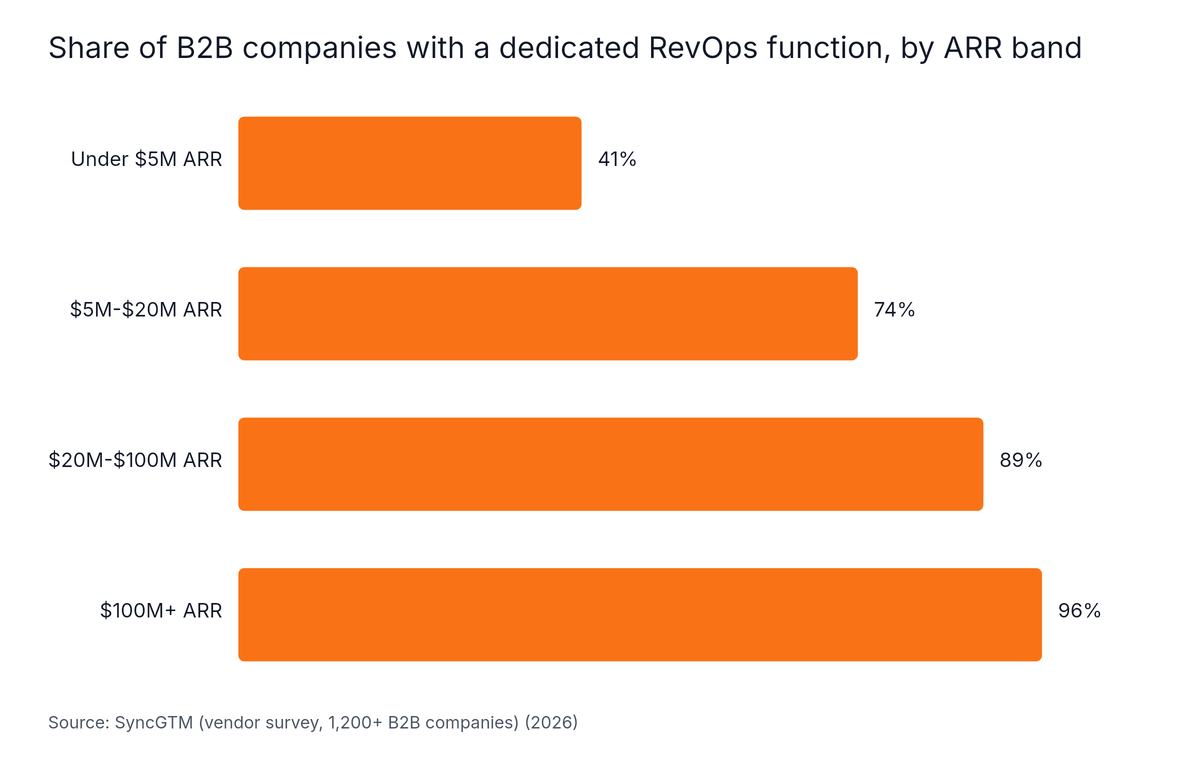
Yes, one RevOps person can run a CRM, native routing rules, a basic enrichment connection and CRM-based reports without an engineer, because these are configured rather than coded. Dedicated RevOps is still uncommon early: 41% of companies under $5M ARR have it, versus 96% at $100M+ ARR (SyncGTM, 2026).
A small set of hand tools laid in a neat row on a workbench
Annual recurring revenue (ARR) is the yearly value of active subscriptions. The SyncGTM figures come from a vendor survey of 1,200+ B2B companies with limited published methodology, so read them as directional. Dedicated RevOps ownership rises steadily across ARR bands, from 41% under $5M to 96% at $100M+.
Horizontal Bar chart: Share of B2B companies with a dedicated RevOps function, by ARR band. Highest: $100M+ ARR at 96%.
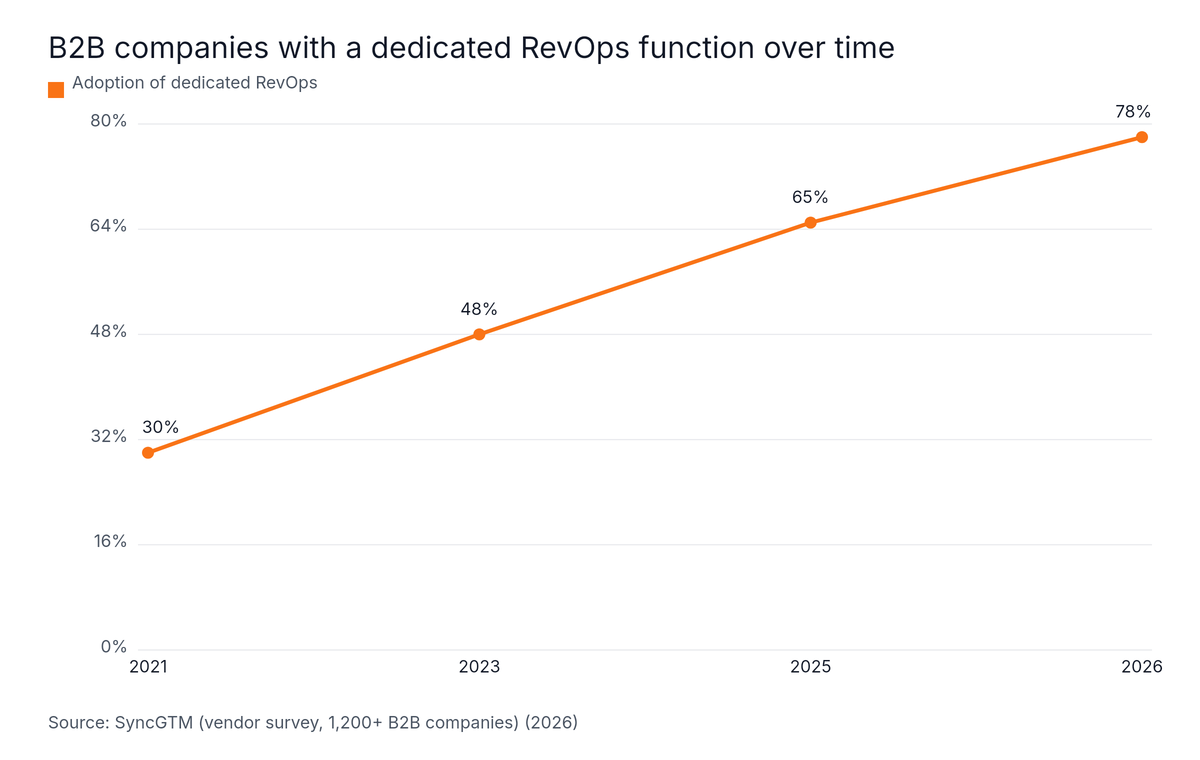
Adoption has also climbed over time. The same survey shows companies with a dedicated RevOps function rising from 30% in 2021 to 78% in 2026 (SyncGTM, 2026).
Line chart: B2B companies with a dedicated RevOps function over time. Highest: 2026 at 78%.
Data hygiene often lands on the solo operator by default. Only 18% of organizations without a full-time employee responsible for CRM data quality plan to hire one in the next twelve months, a 56% decrease from 2024 (Validity, 2025). Scope the stack to what one person can keep clean.
How many tools should the stack hold, and what can wait?
The average revenue operations tech stack holds about 12 tools, while top performers run 7 to 8, according to a 2026 vendor survey (SyncGTM, 2026). That survey also found 67% of RevOps leaders plan to cut tool count. The practical rule is to add a tool only when a named problem and clean data both exist.
Tool count is a symptom, not a target. The survey's questionnaire is not published, so use it as a direction. Items that usually wait until Series B or later:
Dedicated forecasting or revenue intelligence software, until stage hygiene is reliable.
Warehouse-based attribution, until engineering support exists.
Extra sales engagement and intent-data tools, until routing and enrichment work.
Any tool that duplicates a field the CRM already holds.
Each skipped tool saves licence cost, admin time and another integration to maintain.
Who is the revenue operations tech stack guide not for?
The revenue operations tech stack guide on this page is not for companies with no sales team and no CRM yet, for B2C or e-commerce operations, or for readers who want a vendor shortlist. It names no default product, and its figures come from surveys such as the 2025 study in which 47% of RevOps professionals rated stack ROI as average or worse (MarketingOps.com, 2025).
Three limits are worth stating plainly:
The research here does not give ARR or rep-count thresholds for each layer, so triggers are framed as problems, not numbers.
Several figures come from vendor surveys with a stated sample but unpublished questionnaires, such as the 12-tool average stack from SyncGTM (2026).
Stage labels are approximate. A team with a long sales cycle and many stakeholders may need a layer earlier than the table suggests.
Frequently Asked Questions
What is the minimum revenue operations tech stack for a Series A B2B SaaS company?
The minimum revenue operations tech stack for a Series A B2B SaaS company is a CRM with written stage definitions, native assignment rules for routing, a click ID stored on every lead, and one shared pipeline report. Enrichment, dedicated attribution and forecasting tools can wait until a specific, named problem justifies them.
Can one RevOps person run a CRM, routing and enrichment stack without an engineer?
Yes, one RevOps person can run a CRM, native routing rules and a basic enrichment connection without an engineer, because these are configured rather than coded. Custom routing code and warehouse-based attribution usually need engineering help. Data hygiene often lands on the solo operator by default, so scope the stack to what one person can keep clean.
Which RevOps tools can be skipped until Series B?
Dedicated forecasting and revenue intelligence software, warehouse-based attribution, and multi-tool sales engagement stacks can usually wait until Series B. The test is whether a named problem, such as repeated forecast misses or unexplained budget decisions, exists and whether clean CRM data is already in place to feed the tool.
When should a company move from spreadsheets to a CRM?
A company should move from spreadsheets to a CRM when more than one person touches the same leads, when deals are lost or double-worked, or when marketing and sales report different numbers for the same quarter. Define stages and clean the data before importing, so the CRM does not inherit the spreadsheet's problems.
Conclusion
A revenue operations tech stack works when each layer arrives only after the one beneath it is clean. With 47% of RevOps professionals rating stack ROI as average or worse (MarketingOps.com, 2025), the order matters more than the count. Build in this sequence:
Write stage definitions and clean the CRM core.
Add native routing rules and measure response time weekly.
Store the click ID and add a self-reported source field.
Add enrichment only when blank fields break routing or scoring.
Add forecasting software only after stage hygiene holds.
If the stack decision is still unclear, bring the funnel, CRM or reporting question to a call and map the next step: Meet with an expert.
Written by
Ishan Manchanda
Ishan Manchanda is co-founder of GrowthSpree, a B2B SaaS marketing consultancy founded in 2017 that has managed $60M+ in ad spend across 300+ B2B SaaS companies. He focuses on demand generation, go-to-market strategy and pipeline growth, and has been featured in Silicon Valley Times, SaaS Mag and the Unbounce podcast.
 Ishan ManchandaNov 24, 2026