Blog
Conversion Path: What It Is and How to Track One Across a Long B2B Sales Cycle
A conversion path is the sequence of touches before a deal converts. See where click IDs expire and how to track a B2B SaaS path across a widely cited 84-day cycle.
How revenue operations and intelligence software flags at-risk pipeline by stage age, velocity and engagement, plus a backtest to run after a forecast miss.
 Ishan ManchandaNov 21, 2026
A conversion path is the sequence of touches before a deal converts. See where click IDs expire and how to track a B2B SaaS path across a widely cited 84-day cycle.
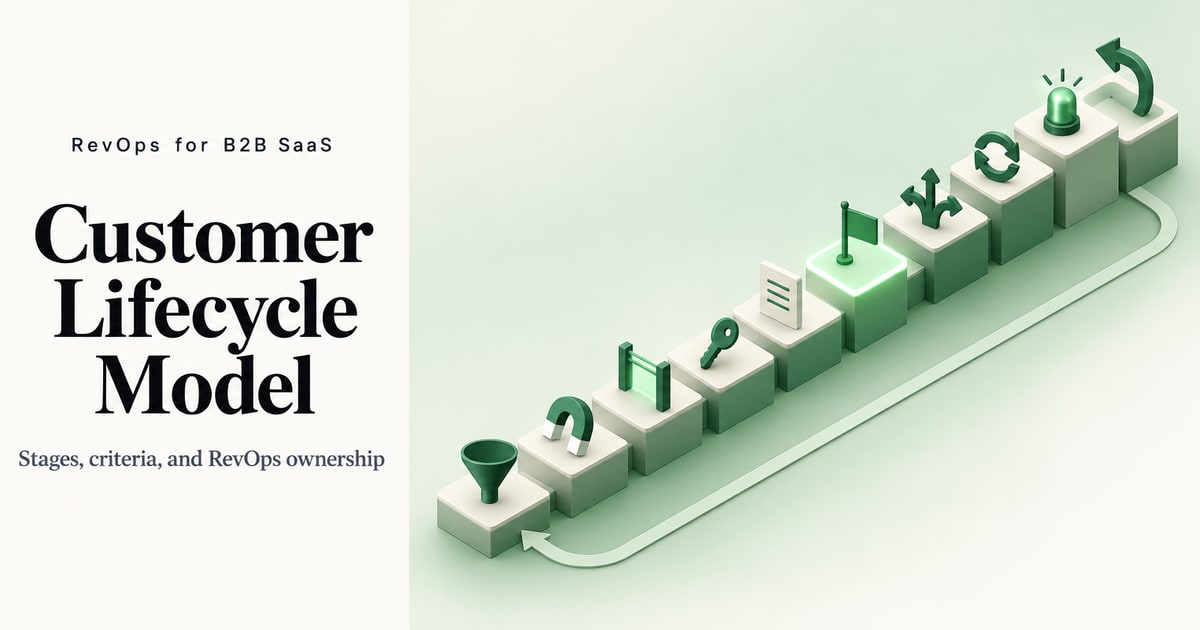
A customer lifecycle model for B2B SaaS: ten stages with entry criteria, triggers, CRM fields and owners, plus how RevOps keeps one number across teams.
ROAS definition, how ROAS differs from ROI, and why platform ROAS rarely matches closed-won revenue in B2B SaaS paid search, with a metric-by-audience guide.
Request a quote and our experts will contact you within 24 hours with tailored solutions and pricing.
Last updated: Nov 21, 2026
By RevOps for B2B SaaS Editorial Team | Last updated: November 4, 2026
Revenue operations and intelligence software is a set of tools that combines customer relationship management (CRM) data, buyer activity and forecasting models to flag at-risk pipeline by stage and deal, early enough to act. A $600K commit miss rarely comes from nowhere. In a vendor-run 2026 survey of 400 enterprise leaders, 87% said their company missed 2025 revenue targets (Clari Labs, 2026). The warning signs usually sat in the pipeline all along. This guide covers what these platforms monitor, which capabilities give early warning, and how a B2B SaaS team running revenue operations (RevOps) can test a vendor against its own missed quarter. For the wider stack, see the guide to revenue operations software.
Key Takeaways
- Revenue intelligence software warns early by scoring each deal on stage age, deal velocity and buyer engagement, not by reading pipeline in aggregate.
- The best test after a forecast miss is a backtest: replay last quarter's deals through each platform and check which misses it would have flagged, and how early.
- Published commit, best-case and weighted accuracy medians carry no stated sample, so they are a rough reference and not a benchmark.
- An AI analytics layer is only as good as the CRM data it reads: 48% of surveyed enterprises say their revenue data is not AI-ready (Clari Labs, 2026).
Revenue operations and intelligence software gives earlier pipeline warnings by scoring each deal on its own signals instead of reading pipeline in aggregate. It tracks stage age, deal velocity and buyer engagement, then flags deals whose pattern departs from your history. In a 2026 Clari Labs survey, 55% of enterprises reported conflicting pipeline signals from disconnected sources (Clari Labs, 2026).

Three signals do most of the work. Each is a deal-level measure that an aggregate pipeline total hides.
Multi-threading is the practice of engaging several contacts at the buyer instead of relying on one. The same analysis reports an average 130% win-rate lift from multi-threading in deals over $50K (Gong Labs, 2025). That is correlational vendor data. Still, it shows why a single-threaded deal in commit is a forecast risk.
No sourced threshold exists for "too old" or "too quiet." Treat any number you read as a starting point. Calibrate flags on your own closed-won history, for example as a multiple of your median time-in-stage.
Published range, no stated sample: Median commit forecast accuracy of 85%, best-case accuracy of 38% and weighted pipeline accuracy of 22% (FA26, 2026). No sample or method is stated, so these are published ranges and not verified benchmarks.
The gap is partly a matter of definition. Commit forecast accuracy compares closed-won value with the amount the team called as commit. Best-case accuracy divides closed-won value by the whole best-case pool, a deliberately large denominator, so a low figure is expected. Compare your own accuracy quarter over quarter before comparing it with anyone else's.
Revenue intelligence software covers four layers: the CRM that stores deals, capture of buyer activity and conversations, forecasting roll-ups by category, and an AI analytics layer that scores deal risk. Gartner now evaluates this space as Revenue Action Orchestration, with its Magic Quadrant published on Oct 13, 2026 (Gong, 2026), so vendor labels overlap.

Revenue intelligence is the use of captured deal activity and AI models to inspect pipeline and predict outcomes at deal level. The table separates the layers, since "forecasting," "revenue intelligence" and "RevOps platform" are often used as if they meant the same thing.
| Layer | What it does | Question it answers |
|---|---|---|
| CRM | Stores accounts, deals, stages and close dates | What is in pipeline today? |
| Activity and conversation capture | Records emails, meetings and calls against deals | Is the buyer engaged, and with how many people? |
| Forecasting | Rolls deals into commit, best case and pipeline categories | What will close this quarter? |
| AI analytics or agents | Scores risk, explains flags, suggests next actions | Which deals are slipping, and why? |
Revenue Action Orchestration (RAO) is Gartner's category name for the market that absorbed standalone sales engagement and revenue intelligence evaluations. Gartner's analysts write that "RAO serves as the primary system of seller action and a single source of truth for sales interactions" (Gartner, via Gong press release, 2026). For the reporting that sits on top of these layers, see what a RevOps reporting dashboard should show.
Revenue operations intelligence tools give early warning when they offer four capabilities: deal-level risk alerts, a commit roll-up comparable with CRM stages, a buyer-contact view and close-date change tracking. The contact view matters because, in 1.8 million opportunities, won deals carried twice as many buyer contacts as lost ones (Gong Labs, 2025). No tool is recommended by default; test each against your own missed deals.

Use the matrix below to check a shortlist. The last column turns each capability into a question a vendor can answer with evidence.
| Capability | Signal watched | Warning it gives | Question for the vendor |
|---|---|---|---|
| Deal risk alerts | Stage age, velocity | A deal stalls before its close date | What triggers an alert, and can I tune it? |
| Commit roll-up | Rep calls versus CRM stages | Commit and stage-weighted pipeline disagree | Can I compare the roll-up with my CRM categories? |
| Buyer-contact view | Contacts engaged per deal | Single-threaded deals in commit | Which contacts count, and from which sources? |
| Close-date tracking | Date changes and slips | Soft commits pushed quarter after quarter | How is history stored for backtesting? |
| Open access (API or MCP) | Deal context exposed to other tools | Risk surfaced inside existing workflows | Which systems can read the deal data? |
As of October 2026, MCP connectors are becoming a standard way to expose revenue intelligence to AI tools, and Clari and Salesloft introduced an MCP server (MarTech, 2026). Treat open access as a plus, not a substitute for the first four rows.
Comparing revenue operations and intelligence platforms after a forecast miss starts with a backtest: replay last quarter's deals through each tool and record which deals it flagged, how many weeks early, and whether the flagged amount covers the gap. With a median sales cycle of 84 days across 104 audited accounts (G26, GrowthSpree, June 2026), export history from deal creation.

An AI analytics platform for sales forecasting should be judged on data readiness first, then on explainable deal scores and CRM write-back. In a 2026 Clari Labs survey of 400 enterprise leaders, 48% said their revenue data is not AI-ready (Clari Labs, 2026), and a model trained on messy fields will forecast on noise.

A short audit shows whether the data can support an AI layer. Check that:
Source data matters too. Ad-sourced pipeline needs a click trail. The guide on ad click tracking in the CRM shows where that trail usually breaks.
What we found: In The 2026 B2B SaaS Google Ads Waste Report (G26, GrowthSpree, June 2026; 104 accounts and $78.0M in spend), 91% of audited accounts had no Google click ID (GCLID) reaching the CRM. After a 90-day attribution fix, the share of closed-won deals traced to a campaign rose from 0% to 67%.
Ownership is a real gap. In the same Clari Labs study, IT teams led AI training and data preparation at 91% of firms, but only 29% of RevOps teams were top contributors (Salesloft, 2026). A RevOps manager running the evaluation should bring IT in early. The guide on consultant versus internal RevOps hire covers who should carry that work.
The AI layer is also still young. 57% of enterprises say AI agents have not been fully deployed across revenue operations (Clari Labs, 2026). The survey figures are charted below: 87% missed 2025 targets, 57% lack full AI agent deployment, 55% see conflicting pipeline signals, and 48% say their data is not AI-ready.
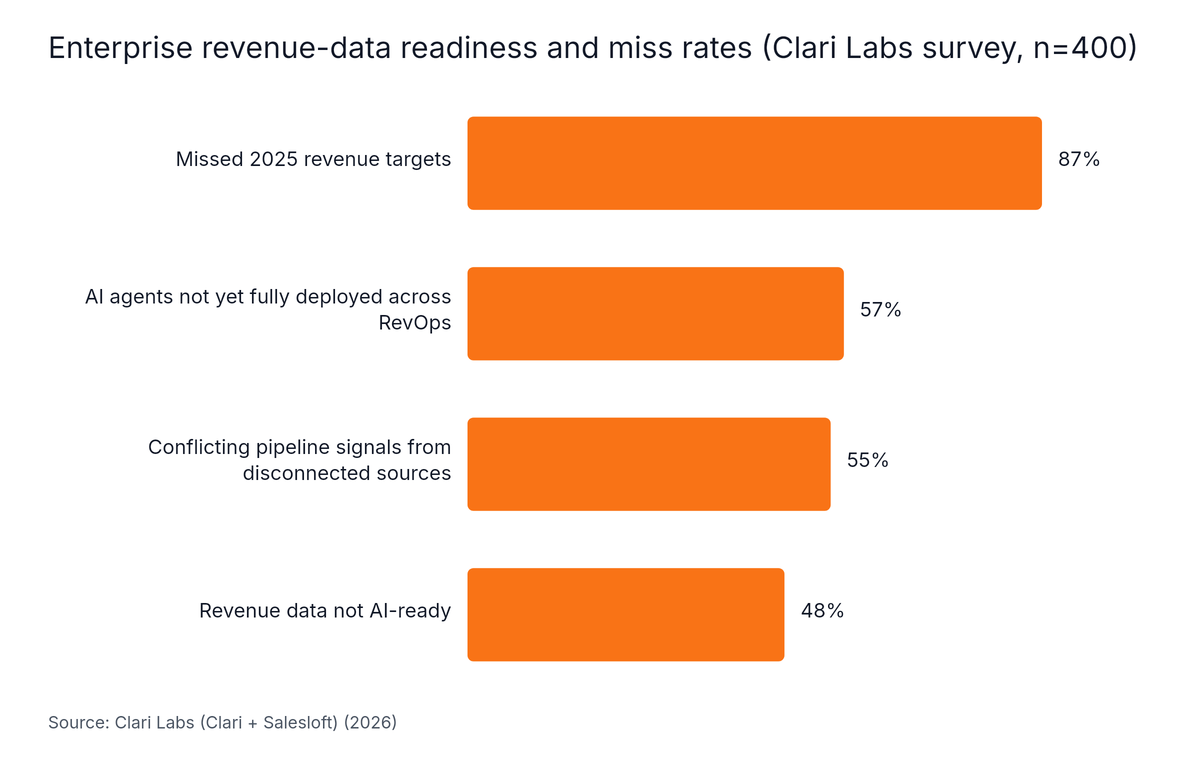
Source: Clari Labs (Clari + Salesloft), 2026
Revenue intelligence software is not for teams whose CRM stages, close dates and next steps are not kept current, or for small B2B SaaS teams already covered by CRM-native inspection. With 48% of surveyed enterprises calling their revenue data not AI-ready (Clari Labs, 2026), a platform amplifies messy data. Write stage definitions first.
Honest limits apply to this guide as well:
Revenue intelligence software covers four layers: the CRM that stores deals, capture of buyer activity and conversations, forecasting roll-ups by category, and an AI analytics layer that scores deal risk. Together they replace gut calls in a weekly meeting with deal-level signals such as stage age, deal velocity and buyer engagement.
Revenue operations intelligence tools give early warning when they provide deal-level risk alerts, close-date change tracking, a buyer-contact view and a commit roll-up that can be compared with CRM stages. No tool is recommended by default. The reliable test is a backtest: replay last quarter's missed deals and check which ones each tool flagged, and how early.
Evaluate revenue intelligence platforms on five points: backtest results against your own missed quarter, the baseline and lead time behind any accuracy claim, how well the tool works on your current CRM data, how explainable each deal flag is, and who will own the platform. Vendor accuracy numbers without a stated sample are not comparable.
An AI analytics platform for sales forecasting should read clean stage history, close-date changes and buyer contacts, then explain why each deal is flagged. Check data readiness first: 48% of enterprises in a 2026 Clari Labs survey said their revenue data is not AI-ready. Then ask for accuracy against a stated baseline, lead time and deal sample.
A missed commit is easier to prevent when pipeline is read by deal, not in total. The points to carry forward:
For a closer look at the data feeding these tools, read how attribution models work. For a second opinion on stage definitions, forecast categories or a vendor shortlist, Meet with an expert for a free consultation.
Written by
Ishan Manchanda
Ishan Manchanda is co-founder of GrowthSpree, a B2B SaaS marketing consultancy founded in 2017 that has managed $60M+ in ad spend across 300+ B2B SaaS companies. He focuses on demand generation, go-to-market strategy and pipeline growth, and has been featured in Silicon Valley Times, SaaS Mag and the Unbounce podcast.