PPC Lead Generation for B2B SaaS: How It Works and What to Measure Beyond Platform Conversions
ppc lead generationppc lead generation for b2b saasgoogle ads conversions vs crm
PPC Lead Generation for B2B SaaS: How It Works and What to Measure Beyond Platform Conversions
How PPC lead generation works in a B2B SaaS funnel, why ad platform conversions differ from CRM pipeline, and three steps to tie ad spend to closed-won revenue.
Request a quote and our experts will contact you within 24 hours with tailored solutions and pricing.
PPC Lead Generation for B2B SaaS: How It Works and What to Measure Beyond Platform Conversions
By RevOps for B2B SaaS Editorial Team | Last updated: November 4, 2026
PPC lead generation is the practice of paying for ad clicks on platforms such as Google Ads and LinkedIn to bring B2B SaaS prospects to a form, then passing those leads through the customer relationship management (CRM) system until a deal closes. Ad platforms often report far more conversions than the CRM shows as closed-won, and the CRM frequently has no source for the deals that did close. That gap is a measurement problem before it is a media problem. This guide explains how the mechanism works, why platform counts and CRM pipeline diverge, and the three steps that connect ad spend to closed-won revenue.
Key Takeaways
PPC lead generation in B2B SaaS only pays off when the ad click is traced through every funnel stage to closed-won revenue.
Ad platforms count form fills; the CRM counts qualified pipeline, so the two totals will not match without deliberate setup.
Connecting ad spend to revenue takes three steps: store the click ID, send qualified stages back as offline conversions, and reconcile on a schedule.
Cost per sales-qualified lead (SQL) is a stronger quality signal for PPC lead generation than cost per lead or click-through rate.
Teams with no CRM or very low lead volume should fix basic tracking before building offline conversion imports.
What Is PPC Lead Generation and How Does It Work for B2B SaaS?
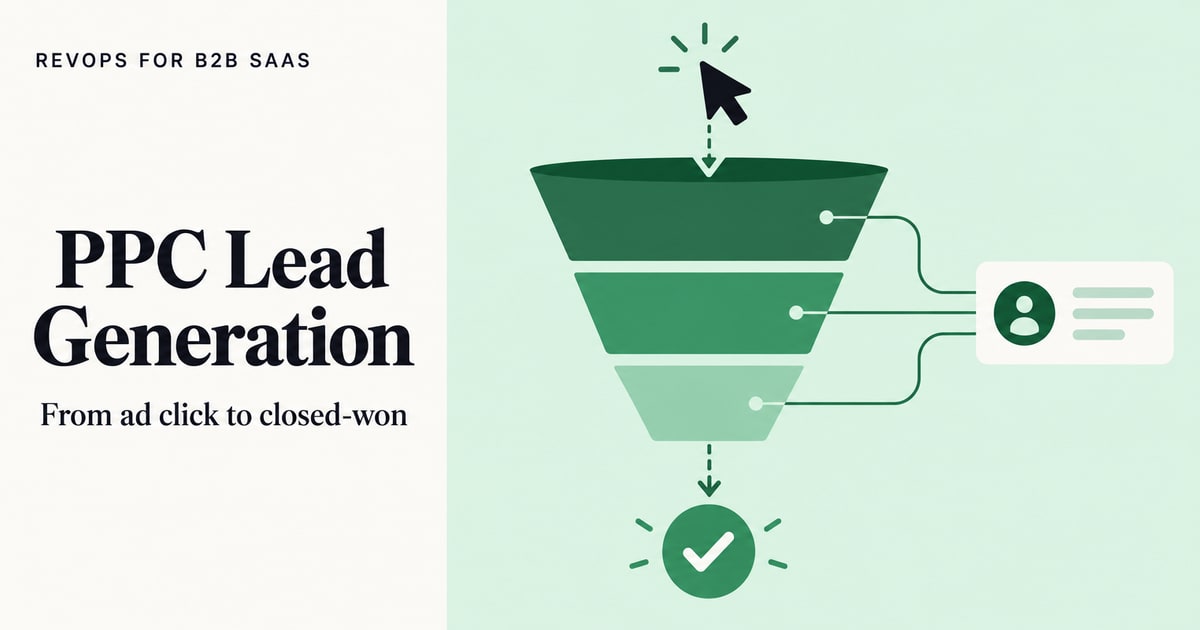
PPC lead generation is a paid acquisition method where a B2B SaaS company pays per ad click and captures contact details through a form. The ad platform records a conversion at the form fill. The CRM then tracks the lead through marketing-qualified lead (MQL), sales-qualified lead (SQL), opportunity and closed-won stages. Non-brand Google Ads search averages a $13.75 cost per click and a 3.94% conversion rate, roughly $207 per lead (Pipe Rocket Digital, 2026).
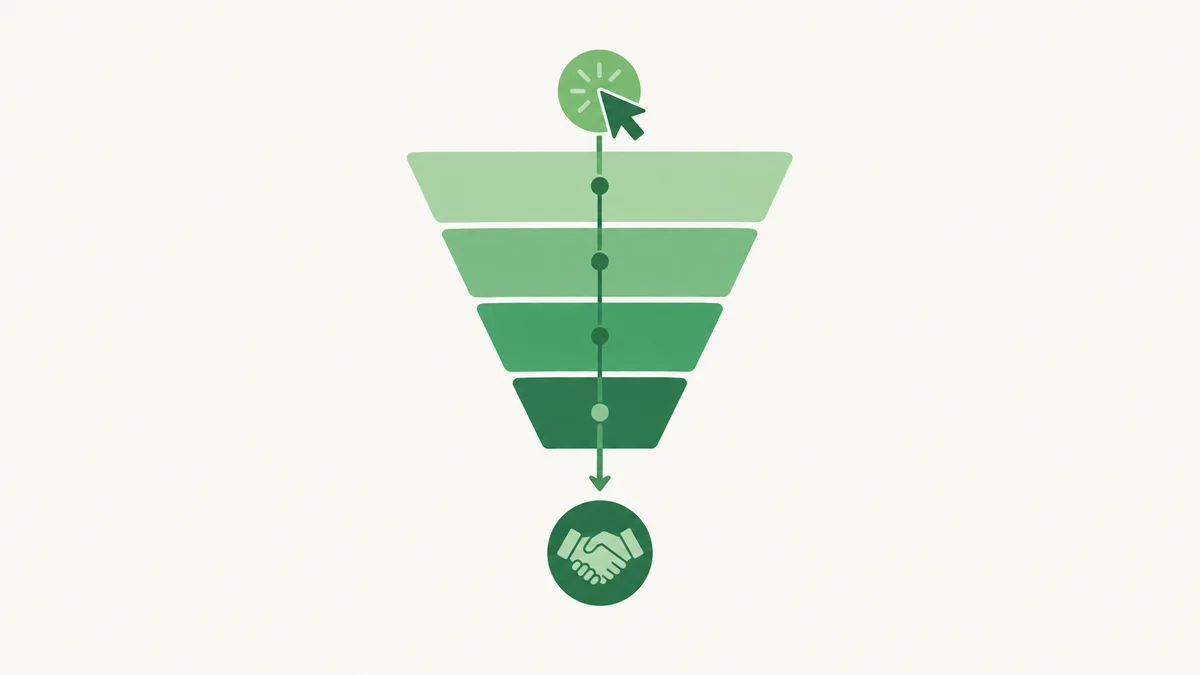
Flat illustration of a funnel with an ad click entering the top and a closed deal leaving the bottom
The mechanism has five moves. A buyer searches or scrolls, clicks an ad, lands on a page and submits a form. The form creates a record in the CRM. Sales and marketing then move that record through stages. The ad platform sees only the first part of that path unless the later stages are sent back.
The funnel stages involved
A marketing-qualified lead (MQL) is a lead that meets a written score or firmographic threshold. A sales-qualified lead (SQL) is a lead that sales has accepted against written criteria. Closed-won is a deal that has signed. Each stage needs one written definition, because the ad platform and the CRM treat them differently.
Why Does Google Ads Show More Conversions Than the CRM?
Google Ads shows more conversions than the CRM because the two systems count different events. The ad platform counts every form fill, often including duplicates and modeled conversions, while the CRM counts only records that reach a stage. In an audit of 104 Google Ads accounts, 78% of form fills never became a sales-qualified lead (GrowthSpree, June 2026).
Two mismatched bar stacks representing ad platform conversion counts and CRM pipeline counts
Our data: In the June 2026 GrowthSpree audit of 104 Google Ads accounts ($78.0M in spend), 78% of form fills never became a sales-qualified lead, 91% of accounts had no Google click ID reaching the CRM, and 89% ran default attribution.
Five mechanisms drive the gap. The table lists each one and the usual fix.
Cause
What happens
Usual fix
Primary and secondary conversion actions mixed
Several actions fire for one lead and inflate the total
Set one primary action per real event
Duplicate firing
A form or tag fires twice on one submission
Check tag firing and deduplicate
Attribution window mismatch
The click window closes before the deal does
Import an earlier stage such as SQL
Modeled conversions
The platform estimates conversions it cannot observe
Compare against CRM records, not totals
Lost click IDs
The click ID never reaches the CRM record
Capture it in a hidden form field
Why long sales cycles widen the gap
New-business B2B deals close in 91 days on average, against 52 days for expansion deals (Webtonic, 2025, reporting Ebsta x Pavilion data). Google Ads' typical click-conversion window is 30 days, and GCLID uploads have a 90-day limit. A closed-won deal may therefore land after the platform has stopped listening.
Measurement itself is getting harder. 87% of B2B marketers say measuring the long-term impact of campaigns is getting harder (AdExchanger, 2025, reporting LinkedIn research with YouGov). Single-touch credit makes this worse, which is why last-touch attribution breaks down on multi-person deals.
How Do You Connect PPC Ad Spend to Closed-Won Revenue?
Connecting PPC ad spend to closed-won revenue takes three steps: store the Google click ID (GCLID) with every CRM lead, send qualified stages back to the ad platform as offline conversions, and reconcile platform and CRM counts on a schedule. In a 90-day attribution fix, the share of closed-won deals traced to a campaign rose from 0% to 67% (GrowthSpree, June 2026).
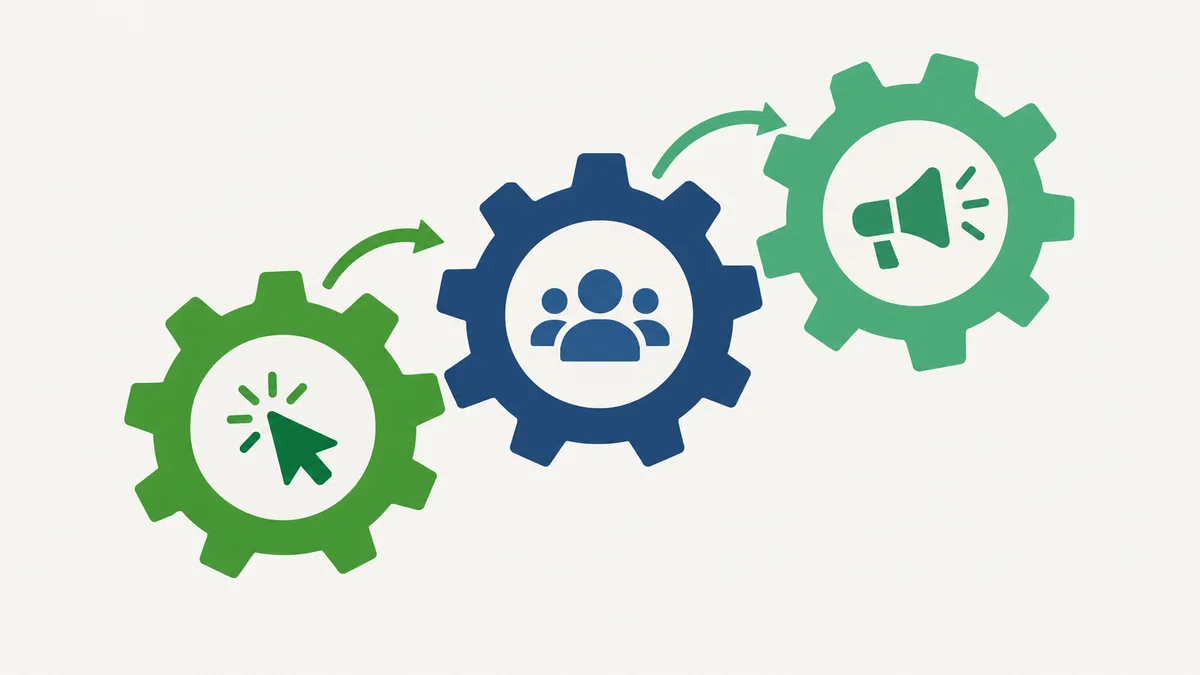
Three connected gears linking a click tag, a CRM record card and an ad platform arrow
Step 1: Store the click ID and UTMs with every lead
A Google click ID (GCLID) is a unique identifier that Google Ads appends to the landing page URL when auto-tagging is on. Without it, a later sale cannot be matched to the click that started it.
Turn on auto-tagging in Google Ads.
Add hidden form fields for the GCLID, UTM source, UTM campaign and UTM medium.
Create matching fields on the CRM lead and contact record.
Map the form fields to the CRM fields and keep them read-only for sales.
Key instruction: the click ID must live on the CRM record, not only in the web analytics tool. Consent for tracking is required in the European Economic Area, the UK and Switzerland, and this guide gives no legal advice.
Step 2: Send qualified stages back as offline conversions
An offline conversion is a sales event recorded in the CRM and sent back to the ad platform, matched to the original click. Google Ads Help states that "offline conversions import and enhanced conversions for leads uploads will be migrated to the Data Manager API" (Google Ads Help, 2026), effective June 15, 2026. The Data Manager API is the Google interface that now handles those uploads.
Since April 2026, "Google Ads will simultaneously accept user-provided data from website tags, Data Manager, and API connections." (Google Ads Help, 2026). Tag-based and uploaded data can run side by side.
Create one conversion action per CRM event, such as Qualified Lead or Opportunity.
Start each new action as secondary, so it does not change bidding while you check the counts.
Send each stage change daily through the Data Manager API or a connector that uses it.
Promote the action to primary once the counts look right.
Cycles are long: new-business deals average 91 days to close (Webtonic, 2025). So bid on an earlier milestone such as SQL and keep closed-won as a reporting action.
Step 3: Reconcile platform and CRM numbers on a schedule
Run a reconciliation every week or month. Compare platform conversions, CRM leads and CRM stage counts for the same campaigns and dates. Agree a tolerance with finance and treat anything outside it as a tracking fault. Revenue operations (RevOps) teams usually own this report. Stage definitions should be co-owned by marketing, sales and finance, and one person should own the click-ID field.
If a funnel, CRM or reporting question is blocking this setup, Meet with an expert for a free consultation. For the wider model choice, the attribution models guide covers when each approach fits.
What Does PPC Lead Generation Cost Beyond Cost Per Lead?
PPC lead generation costs more than cost per lead suggests, because most leads never reach closed-won. Blended B2B SaaS Google Ads cost per lead fell 36% year over year, from $132 to $84 (Pipe Rocket Digital, 2026). Cost per SQL is a better guide: across 1,412 ad variants it tracked pipeline at a 0.71 correlation, against 0.09 for click-through rate (GrowthSpree, June 2026).
Stacked coins of different heights showing cost per lead versus cost per closed deal
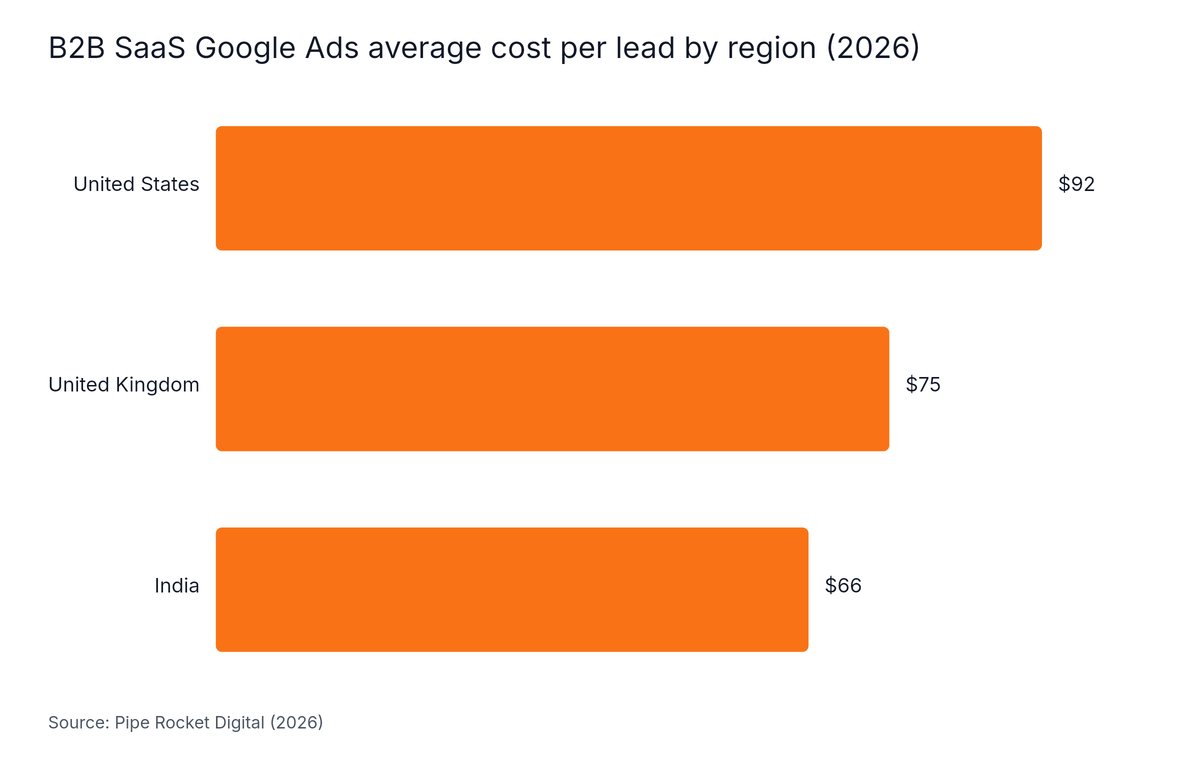
Region changes the starting point. B2B SaaS Google Ads cost per lead averages $92 in the United States, $75 in the United Kingdom and $66 in India (Pipe Rocket Digital, 2026).
Horizontal Bar chart: B2B SaaS Google Ads average cost per lead by region (2026). Highest: United States at $92.
Cost per SQL is ad spend divided by the number of sales-qualified leads that spend produced. A published median for B2B SaaS Google Ads is $800 to $2,500 per SQL (GrowthSpree, April 2026). The table sets the metrics side by side:
Metric
Figure
What it tells you
Blended cost per lead
$84 (Pipe Rocket Digital, 2026)
Cheapest signal, weakest link to revenue
Non-brand cost per lead
$207 (Pipe Rocket Digital, 2026)
Cost of cold search demand
MQL to SQL, Google Ads
13% to 18% median (GrowthSpree, April 2026)
Lead quality after the form
Cost per SQL
$800 to $2,500 published median (GrowthSpree, April 2026)
Cost of real sales interest
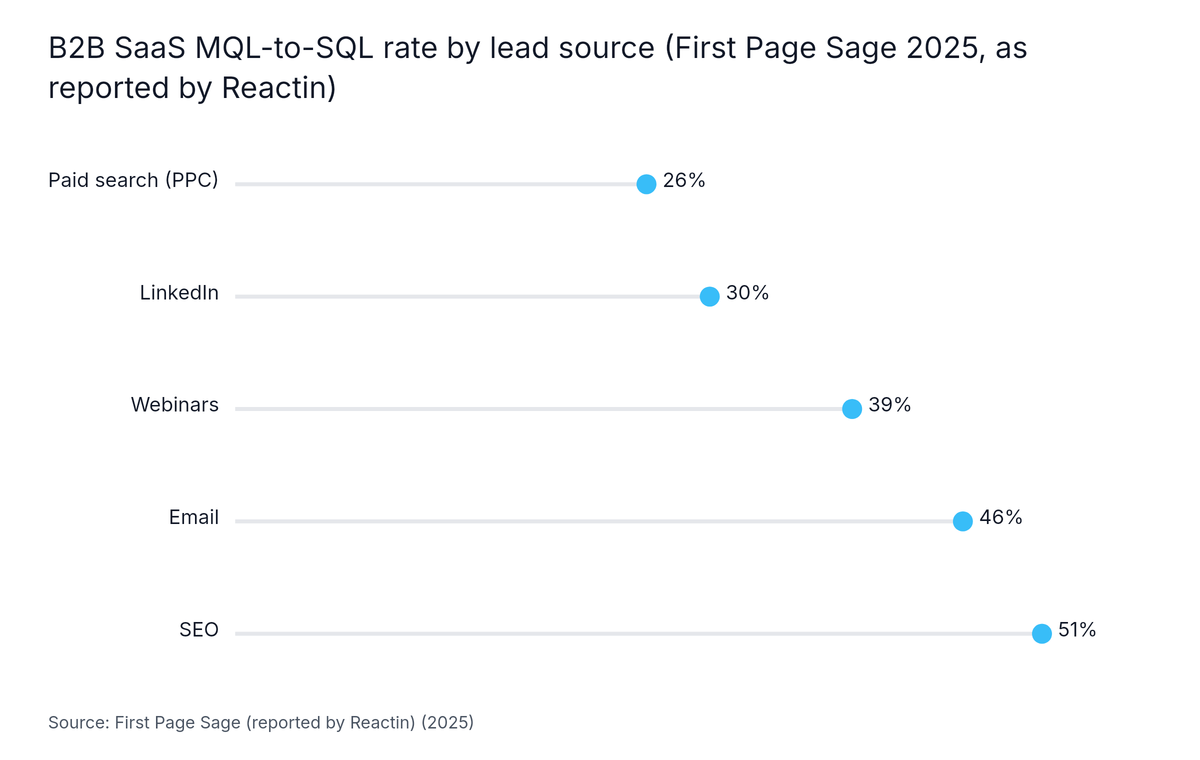
Channel matters too. First Page Sage benchmarks, as reported by Reactin (2025), put MQL-to-SQL at 26% for paid search, 30% for LinkedIn, 39% for webinars, 46% for email and 51% for SEO. The GrowthSpree range uses separate stage definitions, so the two sources are not averaged.
Lollipop chart: B2B SaaS MQL-to-SQL rate by lead source (First Page Sage 2025, as reported by Reactin). Highest: SEO at 51%.
Cost per closed-won is cost per lead divided by the share of leads that become customers. Chaining First Page Sage's B2B SaaS stage rates, leadsnow.ai concludes that a paid search lead needs about three times the volume per deal that an SEO lead does (leadsnow.ai, 2025). That chained result is leadsnow.ai's calculation, not a figure First Page Sage published. Use your own CRM rates for the real number.
How Can You Check That the PPC Attribution Setup Worked?
A working PPC attribution setup shows a GCLID on nearly every paid lead in the CRM, offline conversions appearing in the ad platform soon after a stage change, and platform and CRM counts that differ by a known, explainable margin. Before the fix, 91% of 104 audited accounts had no Google click ID reaching the CRM (GrowthSpree, June 2026).
A checklist card with ticks next to a balanced scale comparing two number blocks
Give the check enough time. With new-business deals averaging 91 days to close (Webtonic, 2025), closed-won results will lag the first month of data. Use this checklist after the first full month, then repeat each quarter:
Click ID coverage: count paid leads with a populated GCLID field. Gaps point to form or consent problems.
Upload status: confirm the Data Manager API or connector reports successful matches for each conversion action.
Stage mapping: check that each CRM stage fires exactly one conversion action.
Source on closed-won: measure the share of closed-won deals with a campaign source. In the audited accounts, this share went from 0% to 67% after a 90-day fix (GrowthSpree, June 2026).
Reconciliation gap: record the difference between platform and CRM counts and watch the trend.
Also review how handling speed affects results. Slow follow-up wastes paid leads, so lead routing software belongs in the same review. Where several people and channels touch one deal, attribution models for long sales cycles show how to credit them.
Who Should Not Build Offline Conversion Tracking for PPC Lead Generation?
PPC lead generation measurement does not suit every team. Companies with no sales team or no CRM, very low lead volume, or heavy reliance on untrackable demand will gain little from offline conversion imports. Anteriad's 2026 survey found that "18% of those surveyed report that they track marketing activity all the way through to closed revenue with a complete attribution model" (Anteriad, 2026).
Sample size and fieldwork dates were not visible, so read the figure as vendor survey evidence. Partial tracking is common. Three honest limits apply:
Untrackable demand: dark-funnel research and word of mouth never carry a click ID. A self-reported "how did you hear about us" field covers part of that gap.
Consent loss: where consent is refused, the platform models conversions and exact matching drops.
Vendor research: the benchmarks above are mostly agency or vendor datasets, and sample details vary.
Why does Google Ads show more conversions than my CRM?
Google Ads counts every tracked form fill, including duplicates and modeled conversions, while the CRM counts only records that reach a defined stage. In an audit of 104 Google Ads accounts, 78% of form fills never became a sales-qualified lead (GrowthSpree, June 2026). The gap is a definitions problem as much as a tracking problem.
What is a GCLID and where should it be stored in the CRM?
A Google click ID (GCLID) is a unique identifier Google Ads appends to the landing page URL when auto-tagging is on. It should be captured in a hidden form field and stored on the lead or contact record in the CRM, so a later stage change can be matched to the original ad click.
How can ad spend be tied to revenue in the CRM?
Three steps connect ad spend to revenue. Store the GCLID or equivalent click parameter with every lead record. Define qualified stages such as SQL or opportunity as offline conversion events. Send those conversions back to the ad platform daily. Google moved custom offline uploads to the Data Manager API from June 15, 2026.
What changed with offline conversion uploads in 2026?
From June 15, 2026, Google Ads moved offline conversion imports and enhanced conversions for leads uploads to the Data Manager API, according to Google Ads Help (2026). Teams that upload CRM stages should check that their connector or script uses the Data Manager API rather than the legacy Google Ads API route.
What is a good MQL to SQL conversion rate?
The answer depends on channel and stage definitions. One benchmark across 50+ clients shows 26% for paid search, 30% for LinkedIn and 51% for SEO (First Page Sage, June 2025). A separate benchmark gives a median of 13% to 18% for B2B SaaS Google Ads (GrowthSpree, April 2026). The First Page Sage and GrowthSpree figures use different stage definitions and should not be averaged.
Conclusion
PPC lead generation works for B2B SaaS when the ad click stays connected to the deal it created. Platform conversions are a starting signal, not a revenue number. Five points to carry forward:
Ad platforms count form fills; the CRM counts pipeline, so totals will differ.
Store the GCLID and UTMs on every CRM lead record.
Send SQL or opportunity stages back as offline conversions through the Data Manager API.
Judge campaigns on cost per SQL and cost per closed-won, not cost per lead alone.
Reconcile platform and CRM counts on a fixed schedule with a written tolerance.
One funnel. One set of definitions. One number everyone trusts. The next step is a short audit: count paid leads in the CRM that carry a click ID, and see how many closed-won deals have a campaign source.
Written by
Ishan Manchanda
Ishan Manchanda is co-founder of GrowthSpree, a B2B SaaS marketing consultancy founded in 2017 that has managed $60M+ in ad spend across 300+ B2B SaaS companies. He focuses on demand generation, go-to-market strategy and pipeline growth, and has been featured in Silicon Valley Times, SaaS Mag and the Unbounce podcast.
 Ishan ManchandaNov 15, 2026