Request a quote and our experts will contact you within 24 hours with tailored solutions and pricing.
By the Editorial Team | Last updated: November 4, 2026
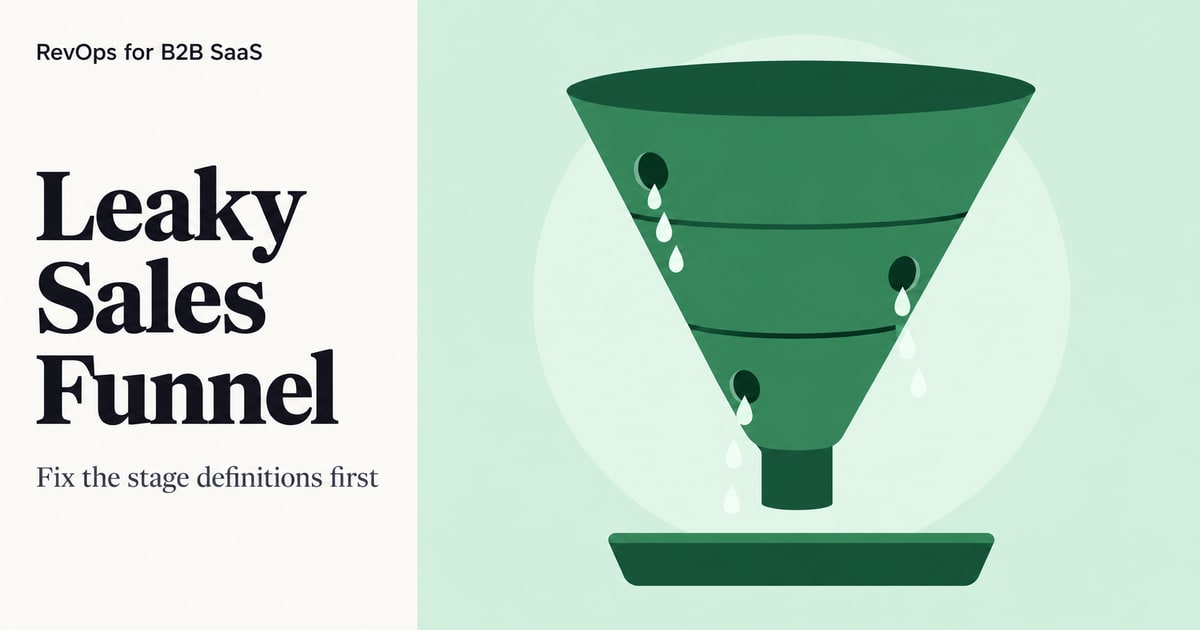
A leaky sales funnel is a B2B SaaS pipeline where leads drop out between stages at rates the team cannot explain, a pattern that often points to stage entry criteria nobody wrote down. The loss starts early: 38% of qualified mid-market buyers who submit a form never book a meeting (Chili Piper, 2026). Marketing counts the form fill, sales counts the pipeline, and the gap between them becomes an argument. This guide maps where B2B SaaS leads drop out, shows how to test for a definition problem versus a quality problem, and explains how written lifecycle stages close the gap. For channel benchmarks, see sales conversion rates in B2B SaaS.
Key Takeaways
A leaky sales funnel in B2B SaaS is a measurable gap between lead count and pipeline, and undefined stage entry criteria are one common, testable cause.
B2B SaaS leads drop out at three points: form fill to first meeting, marketing-qualified lead (MQL) to sales-qualified lead (SQL), and SQL to closed-won.
A definition problem and a lead quality problem look different in rejection reason codes, time-in-stage and conversion by source.
Every lifecycle stage in a B2B SaaS funnel needs a written entry criterion, exit criterion, owner and response target.
Funnel benchmarks conflict because their denominators and stage definitions differ, so each number must be read with its source.
What causes a leaky sales funnel?
A leaky sales funnel is often traced to stage entry criteria that nobody wrote down, though audit figures measure the size of a leak, not its cause. In an audit of 104 Google Ads accounts, 78% of form fills never became a sales-qualified lead (SQL) (GrowthSpree, June 2026). Whether those fills were weak leads or poorly defined stages needs a separate test.
Flat illustration of a funnel with three leaking holes and droplets falling into a tray
The causes cluster into four groups. Each one produces a number that can look like a quality problem while behaving like a definition or handoff problem.
Cause
What it looks like
Evidence
Undefined stage entry criteria
Form fills counted as leads, sales rejects most of them
Most form fills in the GrowthSpree audit of 104 Google Ads accounts never reached SQL (GrowthSpree, June 2026)
No click ID in the CRM
Ad platform reports conversions, the CRM shows no source
91% of 104 audited accounts had no Google click ID reaching the customer relationship management (CRM) system (GrowthSpree, June 2026)
Default attribution
Spend cannot be tied to pipeline
89% of 104 audited accounts ran default attribution (GrowthSpree, June 2026)
Slow or manual handoff
Qualified buyers never book
38% of qualified mid-market buyers who submit a form do not book a meeting (Chili Piper 2026 Web Conversion Benchmark, 2026)
Why form fills are not leads
A Google click ID (GCLID) is the click parameter Google Ads appends to a landing page URL so a lead can be traced to an ad click. When it never reaches the CRM, marketing cannot see which campaigns produce SQLs, and bidding learns from form fills instead. Practical fixes for this break are covered in how ad click tracking breaks between the ad platform and the CRM.
Key figures (GrowthSpree, June 2026): After a 90-day attribution fix, the share of closed-won deals traced to a campaign went from 0% to 67%. Across 1,412 ad variants in 96 accounts, cost per SQL tracked pipeline at a correlation of 0.71, against 0.09 for click-through rate.
Where do leads most commonly drop out of a B2B SaaS sales funnel?
B2B SaaS leads most commonly drop out at three points: between form fill and first meeting, between marketing-qualified lead (MQL) and SQL, and after SQL on the way to closed-won. Chili Piper's 2026 benchmark of 2.9 million mid-market submissions found that 38% of qualified buyers who submit a form do not book a meeting (Chili Piper, 2026).
Form fill to first meeting
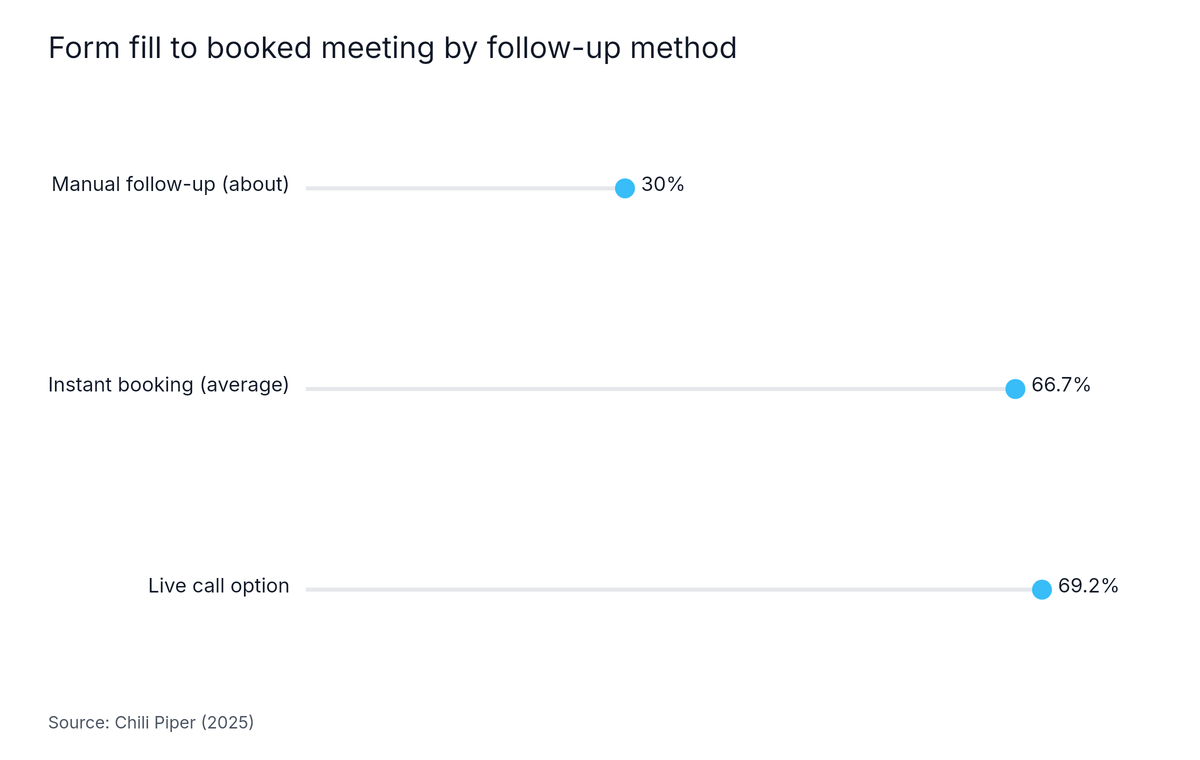
Speed and booking friction decide this step. Qualified demo-form submissions that book a meeting average 66.7% when booking is instant, versus about 30% with manual follow-up (Chili Piper, 2025). The same report's live call option reaches 69.2%. When the booking page shows the combined open times of every rep who could take the meeting, 76% of routed form submissions book (Chili Piper, 2026). Both reports are vendor data from Chili Piper's own customer base, so read them as directional. Routing design is covered in lead routing software for B2B SaaS.
Lollipop chart: Form fill to booked meeting by follow-up method. Highest: Live call option at 69.2%.
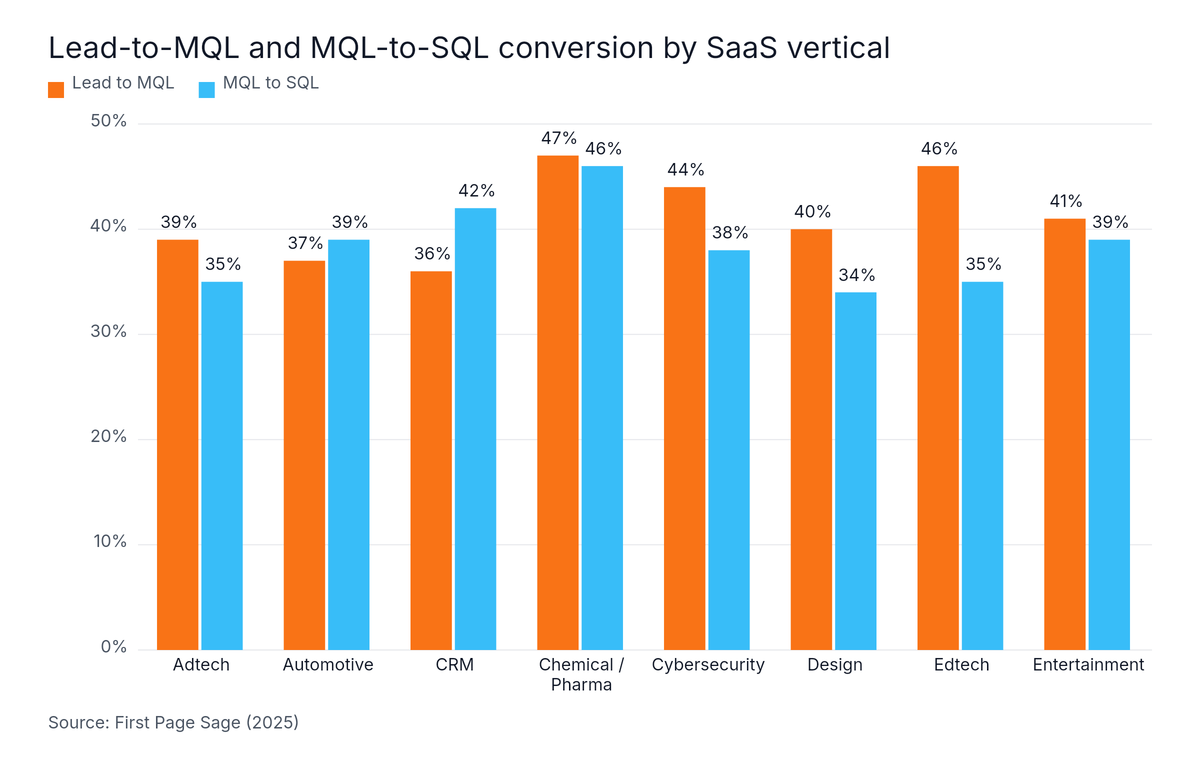
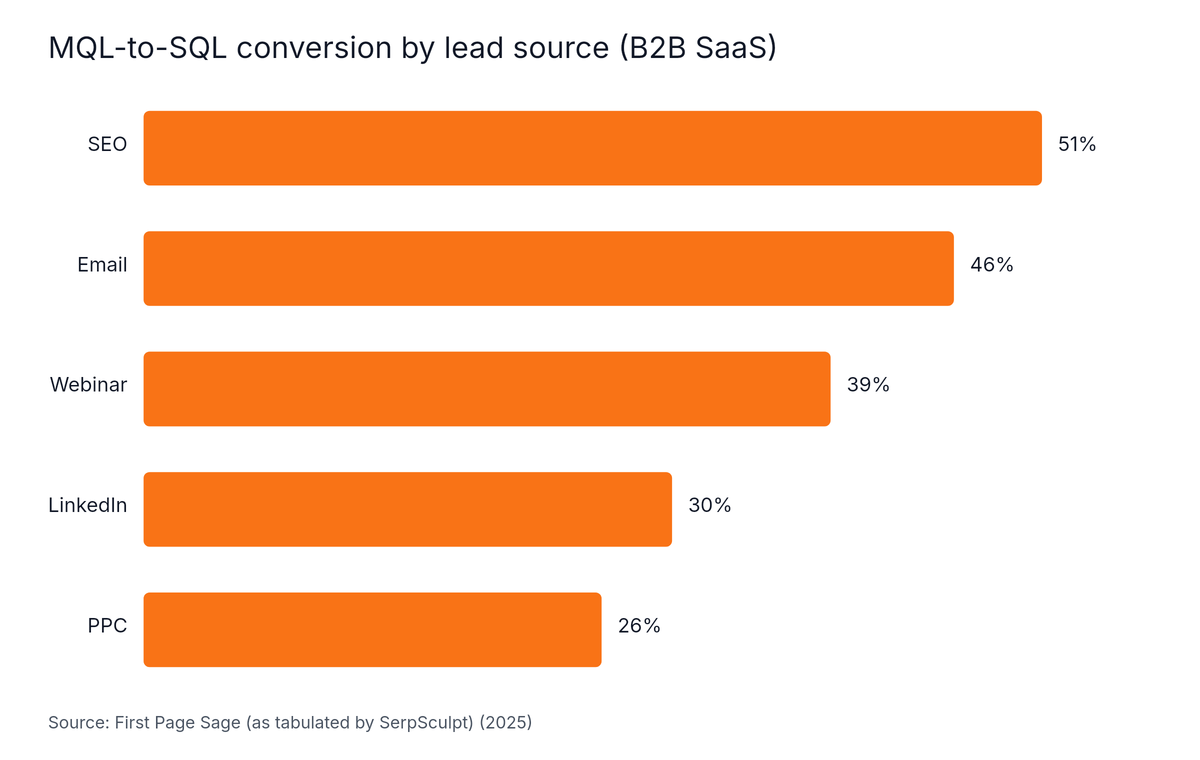
A marketing-qualified lead (MQL) is a lead that meets a defined score or firmographic threshold set by marketing. Conversion from MQL to SQL depends heavily on source. In First Page Sage's channel figures, tabulated by SerpSculpt, SEO converts 51%, email 46%, webinar 39%, LinkedIn 30% and PPC 26% (First Page Sage via SerpSculpt, 2025). Vertical matters too: cybersecurity SaaS converts 44% of leads to MQL and 38% of MQLs to SQL (First Page Sage, 2025). That benchmark comes from an agency client base, mostly companies with $10M to $100M in revenue, and is not a random sample.
Grouped Bar chart: Lead-to-MQL and MQL-to-SQL conversion by SaaS vertical. Highest: Chemical / Pharma at 47%.
The leak continues after SQL. The average B2B win rate across all created opportunities fell to 19% in 2025, down from 29% in 2024 (Ebsta x Pavilion via SaaSletter, 2025). Another analyst cut reports different year-on-year figures, so the denominator matters: this one counts all created opportunities.
Dropout point
Metric
Published figure
Form fill to first meeting
Qualified buyers who do not book
38% (Chili Piper 2026 Web Conversion Benchmark, 2026)
Form fill to first meeting
Booking rate, instant vs manual
66.7% vs about 30% (Chili Piper 2025 Demo Form Benchmark, 2025)
MQL to SQL
Conversion by channel
26% PPC to 51% SEO (First Page Sage via SerpSculpt, 2025)
Opportunity to closed-won
Win rate, all created opportunities
19% in 2025 (Ebsta x Pavilion 2025 GTM Benchmarks, 2025)
How can you tell a definition problem from a lead quality problem?
Low MQL to SQL conversion points to a definition problem when rejection reasons are vague, time-in-stage varies widely and results change with the reviewer. It points to a lead quality problem when one source is rejected for the same reason every time. Channel mix alone moves the rate from 26% for PPC to 51% for SEO (First Page Sage via SerpSculpt, 2025).
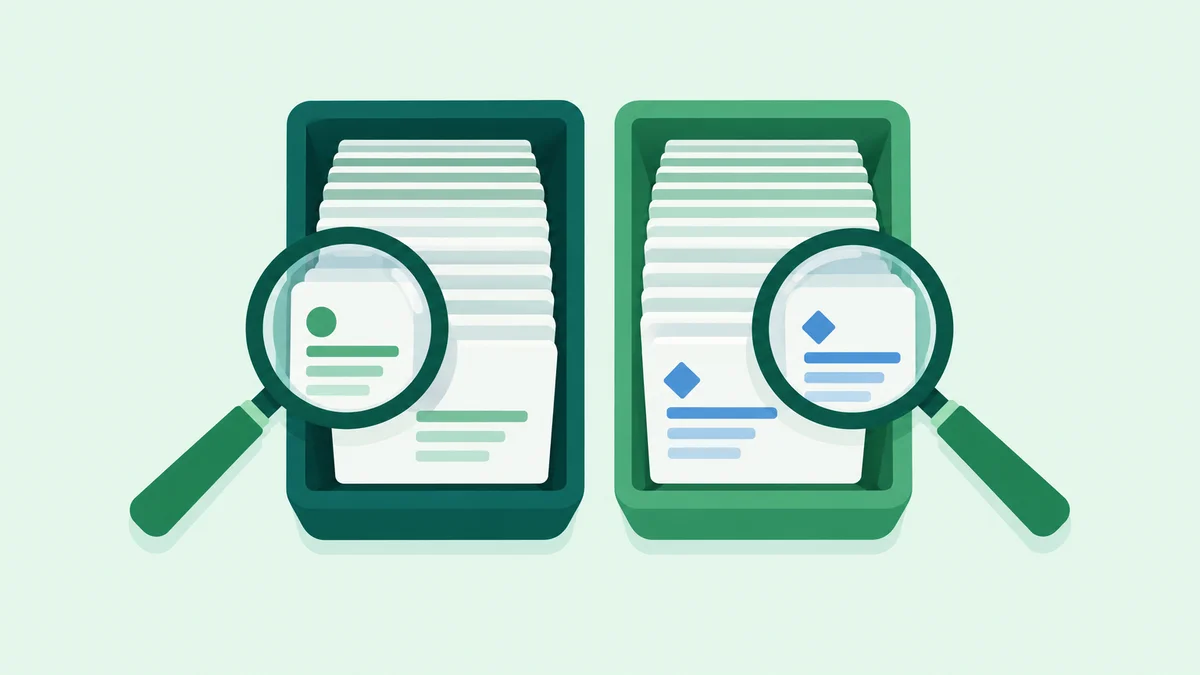
Flat illustration of two magnifying glasses over a sorted stack of lead cards
The diagnostic needs four reads from the CRM. None requires new tooling, only a required reason field and a stage timestamp.
Test
What to measure
Reads as a definition problem when
Reads as a lead quality problem when
Rejection reason codes
SAL and SQL rejections by reason
"Not ready" or "other" dominates
One concrete reason repeats within a source
Time in stage
Days between stage timestamps
Wide spread, with leads stalling untouched
Leads move fast, then get rejected
Conversion by source
MQL to SQL per channel
Rates swing with the reviewer or week
Rates are stable and low for one source
Before and after
Conversion after a written definition change
Rate shifts with no change in lead mix
Rate stays flat after the rule change
Compare channels under the same stage definitions only. First Page Sage's channel range and GrowthSpree's April 2026 median of 13% to 18% MQL to SQL for B2B SaaS Google Ads, a published range with no stated sample, define stages separately. Averaging them would blend two sets of rules.
What are the standard stage definitions for a B2B SaaS sales funnel?
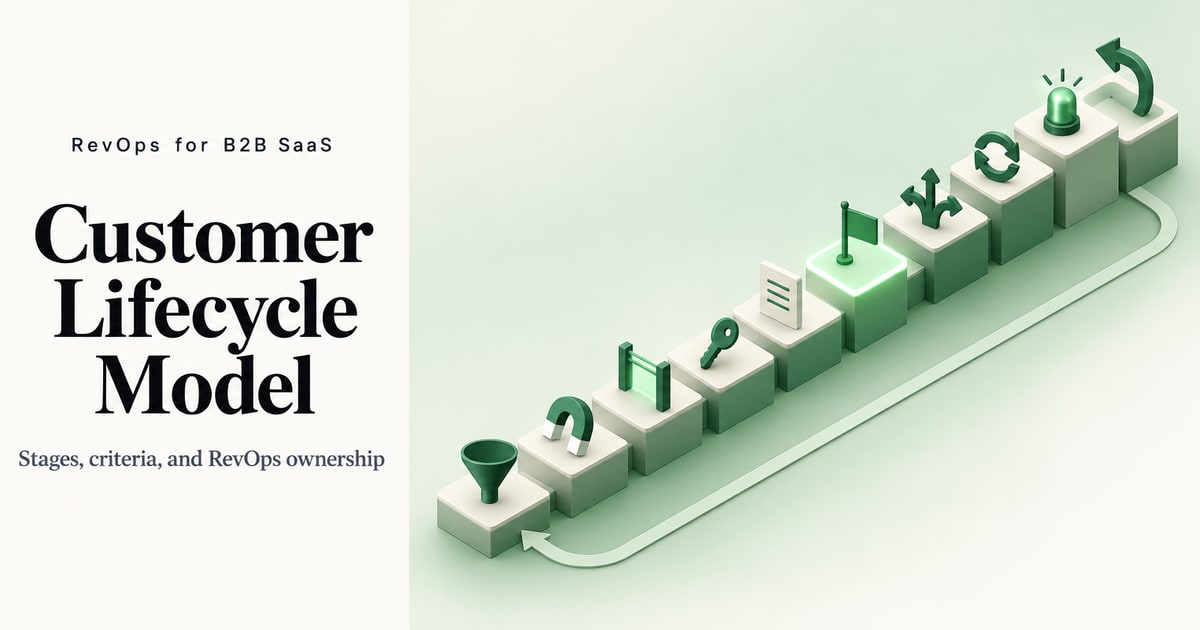
A common B2B SaaS sales funnel has five lifecycle stages: lead, marketing-qualified lead (MQL), sales-accepted lead (SAL), sales-qualified lead (SQL) and opportunity, ending in closed-won. Each stage needs a written entry criterion tied to a buyer action, an exit criterion, an owner and a response target. Teams add a SAL when the CRM default lacks one.
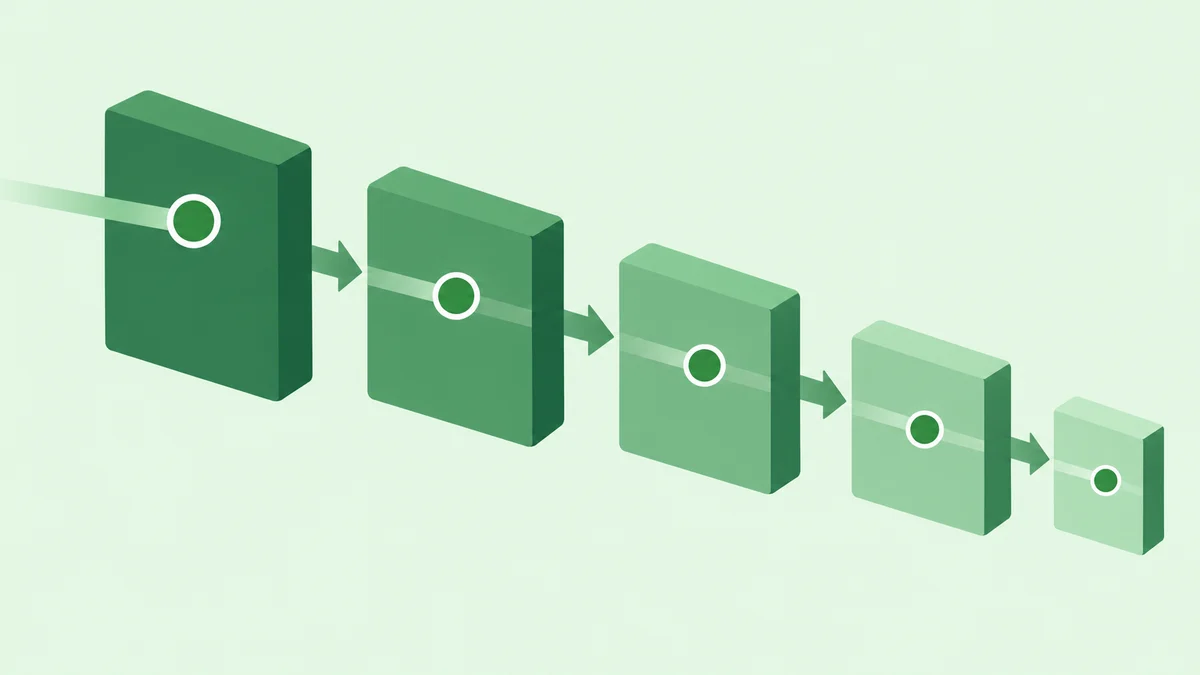
Flat illustration of five stacked stage blocks connected by arrows from lead to closed-won
A lifecycle stage is a named position in the funnel with a written entry criterion, exit criterion, owner and response target. A sales-accepted lead (SAL) is an MQL that sales has reviewed and agreed to work. A sales-qualified lead (SQL) is a lead that sales has accepted against written qualification criteria, such as confirmed need, budget range and a named contact role.
Stage
Entry criterion (buyer action)
Exit criterion
Owner
Response target
Lead
Form fill or inbound contact with a valid business email
Meets MQL threshold, or disqualified
Marketing
Routed on submission
MQL
Meets the agreed score or firmographic threshold
Sales accepts or rejects with a reason code
Marketing
Team-set review window
SAL
Sales accepts the MQL for follow-up
First conversation held, or recycled
Sales development
Team-set, measured weekly
SQL
Written qualification criteria confirmed on a call
Opportunity created, or recycled
Sales
Reviewed weekly
Opportunity
Defined buyer commitment, such as a scoped evaluation
Closed-won or closed-lost
Sales
Stage aging reviewed weekly
The response targets are each team's own choices, not published benchmarks. No source in this guide supports a specific response window.
Individual leads or buying groups
Forrester's 2026 State of Business Buying places the typical decision at 13 internal stakeholders plus nine external influencers, with procurement a decision-maker in 53% of cycles (Forrester, 2026). As Forrester's Barbara Winters put it, "B2B marketers must develop dynamic, role-specific insights that capture how buyers evaluate risk, seek information, and define success for their business purchase" (Forrester, 2026). Many teams therefore add an account-level qualification check on top of the lead stages.
Gartner reports a related shift at the handoff. In its words, "the role of sellers is shifting from acting as the primary source of information to becoming a source of validation and confidence" (Gartner via MarTech Series, 2026). The definitions above should be reviewed when that handoff moves.
How do written stage definitions fix a leaky sales funnel?
Written stage definitions close a leaky sales funnel by turning each handoff into a testable rule instead of a judgment call. Teams with connected CRM, marketing automation and predictive models convert qualified accounts to pipeline at 22% or better, against a 14% baseline for less integrated teams (Demand Gen Report via Sirocco Group, 2026).
Flat illustration of a checklist clipboard beside a gear and a closed pipe joint
The same Demand Gen Report benchmark, which surveyed more than 250 marketing and go-to-market leaders, found that around 73% of B2B organizations restructured their pipeline approach in the past 18 months (Demand Gen Report via Sirocco Group, 2026). Qualification itself is a revenue lever. Highly qualified deals close at 50% versus 8% for poorly qualified deals (Ebsta x trumpet via trumpet, 2025). The source gives no sample size, so treat the gap as directional.
How to write the definitions
Inventory the current handoffs. List every point where a record changes owner: form fill, MQL, SAL, SQL and opportunity. Note what each team believes triggers it.
Write one entry and exit criterion per stage. Tie each to a buyer action, such as a demo request or a confirmed need, not a seller opinion.
Assign an owner and a response target. One named team owns each stage, and each target is measured weekly.
Require a reason code on every rejection or recycle. This feeds the diagnostic tests above.
Send qualified stages back to the ad platform. Store the GCLID with every lead and pass SQL or opportunity events back as conversions. Google moved custom offline uploads to the Data Manager API from June 15, 2026.
Review quarterly, or when conversion rates drift. Record changes in one place so every report uses the same stage model.
Teams that want a second pair of eyes on their stage model can Meet with an expert for a free consultation. Attribution choices that sit on top of these stages are compared in marketing attribution models.
Who is this not for, and what are the limits?
Written stage definitions for a B2B SaaS sales funnel do not fix every leak: they will not repair weak targeting, a poor offer or losses after SQL. The benchmarks are bounded too. Chili Piper's 2026 mid-market report covers 2.9 million form submissions, all from its own platform (Chili Piper, 2026), so every figure here is a range, not a target.
Flat illustration of a balance scale weighing a small funnel against a blank block
Keep these limits in mind:
Vendor and agency benchmarks. Chili Piper's 2025 figures come from about 4 million submissions across its customers. The First Page Sage figures come from an agency client base and are not a random sample.
Secondary reports. The Demand Gen Report, Ebsta and channel-tabulation figures are cited through secondary reports, so check the upstream originals before using them in a board deck.
Paid search only. The Google Ads figures cited here do not describe LinkedIn, SEO or outbound motions.
Companies without a CRM or sales team. A funnel with no CRM and no sales team has no handoff to define yet.
Last-touch reporting. Fixing stages does not fix credit assignment. The limits of that model are covered in last-touch attribution.
Frequently Asked Questions
Where do leads most commonly drop out of a B2B SaaS sales funnel?
B2B SaaS leads most often drop out between form fill and first meeting, between marketing-qualified lead and sales-qualified lead, and after SQL on the way to closed-won. Chili Piper's 2026 mid-market benchmark found 38% of qualified buyers who submit a form do not book a meeting, and MQL to SQL ranges from 26% for PPC to 51% for SEO in First Page Sage's 2025 channel figures.
What are the standard stage definitions for a B2B SaaS sales funnel?
A common B2B SaaS funnel uses lead, marketing-qualified lead (MQL), sales-accepted lead (SAL), sales-qualified lead (SQL), opportunity and closed-won. Each stage needs a written entry criterion tied to a buyer action, an exit criterion, an owner and a response target. Definitions should be recorded once and reviewed when conversion rates drift.
What is a good MQL to SQL conversion rate for B2B SaaS?
A good MQL to SQL rate depends on channel and on how stages are defined. First Page Sage's channel figures, tabulated by SerpSculpt in 2025, range from 26% for paid search to 51% for SEO. GrowthSpree's April 2026 benchmark gives a median of 13% to 18% for B2B SaaS Google Ads, a published range with no stated sample. The sources define stages separately, so average neither.
How fast should sales respond to an inbound demo request?
Instant booking lifts the booking rate of qualified demo-form submissions to 66.7% on average, against about 30% with manual follow-up, in Chili Piper's 2025 benchmark of about 4 million submissions. No verified response-time benchmark supports a specific window, so any target is the team's own, set and reviewed weekly.
Conclusion
A leaky sales funnel is a measurement and definition question before it is a lead question. The benchmarks cited here size the leak, and a written stage model is the first thing to check.
Treat a high form-fill dropout as a prompt to check definitions before blaming lead quality.
Watch the three dropout points: form fill to meeting, MQL to SQL, and SQL to closed-won.
Use reason codes, time-in-stage and conversion by source to separate definition problems from quality problems.
Write an entry criterion, exit criterion, owner and response target for every lifecycle stage.
Send SQL events back to the ad platform with the GCLID stored in the CRM.
The next step is to pull last quarter's rejected leads and tag each with a reason. Then compare the stage rules against the sales conversion benchmarks. One funnel. One set of definitions. One number everyone trusts.
Written by
Ishan Manchanda
Ishan Manchanda is co-founder of GrowthSpree, a B2B SaaS marketing consultancy founded in 2017 that has managed $60M+ in ad spend across 300+ B2B SaaS companies. He focuses on demand generation, go-to-market strategy and pipeline growth, and has been featured in Silicon Valley Times, SaaS Mag and the Unbounce podcast.
 Ishan ManchandaNov 19, 2026