Incrementality vs. Attribution: What Each Measures and Why B2B SaaS Teams Need Both
incrementality vs attributionincrementality testingbranded search incrementality
Incrementality vs. Attribution: What Each Measures and Why B2B SaaS Teams Need Both
Incrementality vs attribution explained: what each measures, where last-touch misleads B2B SaaS, and how to test branded search lift over a long sales cycle.
Request a quote and our experts will contact you within 24 hours with tailored solutions and pricing.
Incrementality vs. Attribution: What Each Measures and Why B2B SaaS Teams Need Both
By the Editorial Team | Last updated: November 4, 2026
Incrementality vs attribution is the difference between measuring causation and measuring credit: attribution assigns conversion credit to touchpoints, while incrementality testing measures how many outcomes would not have happened without the spend. The gap matters most in B2B SaaS. 6sense's 2026 buyer report found vendors left off the initial shortlist have under a 10% chance of winning (Demand Gen Report, 2026). By the time a buyer types the vendor's name into Google, the decision is mostly made, yet last-touch reporting hands branded search the win. This guide explains what each method measures, how to test incrementality over a long sales cycle, and where each one misleads. It builds on the wider attribution models overview.
Key Takeaways
Attribution answers "which touch got credit"; incrementality testing answers "would this outcome have happened without the spend."
Branded search often wins last-touch credit in B2B SaaS because buyers search for a vendor they already prefer.
A B2B SaaS incrementality test needs a holdout window of at least one median sales cycle plus customer relationship management (CRM) lag, read at opportunity or closed-won stage.
Attribution is the fast, always-on view; incrementality tests calibrate it. B2B SaaS teams need both.
What Is the Difference Between Incrementality and Attribution?
The difference between incrementality and attribution is the question each answers. Attribution is a method that assigns credit for a conversion to recorded touchpoints. Incrementality is the measured lift that spend causes beyond what would have happened anyway. Attribution describes the path; incrementality tests the cause.
The table below sets the two side by side.
Dimension
Attribution
Incrementality testing
Question answered
Which touchpoints get credit?
Did the spend cause extra outcomes?
Data used
Recorded clicks, forms and CRM records
Exposed group versus holdout group
Speed
Always on, updated daily
Periodic, needs a full test window
Main strength
Granular view by campaign and channel
Causal evidence for budget decisions
Main weakness
Credit is not proof of cause
Needs volume, time and clean tracking
Best use
Weekly optimization
Budget shifts and calibration
Neither method is sufficient alone. The Interactive Advertising Bureau's State of Data 2026 report found that 60% to 75% of 400+ buy-side decision-makers say current attribution, incrementality and media mix modeling approaches fall short on rigor, timeliness, trust and efficiency (IAB, 2026). The report describes pressures that "have made it harder to connect media exposure to outcomes with confidence" (IAB, 2026).
Why Does Branded Search Get So Much Credit in Last-Touch Attribution?
Branded search gets so much credit in last-touch attribution because the buyer searches for the vendor's name after the real persuasion already happened. Last-touch attribution is a model that gives all conversion credit to the final recorded touch. In B2B SaaS, that touch can be a branded Google search, and 6sense's 2026 report says buying groups pick their favored vendor before seller contact 82% of the time (Demand Gen Report, 2026).
A marketing operations manager places a sticky note on a glass wall divided into two groups of notes.
How the credit ends up in the wrong place
Demand is built earlier, through content, peers, events and outbound. The buyer then searches the vendor name, clicks the paid ad and fills in a form. A last-touch report logs one click and credits branded search. The channels that created the preference get nothing. The last-touch attribution guide covers where that model breaks down.
Tracking gaps make it worse. Credit can only be assigned to touches the CRM can see.
Audit data: GrowthSpree's June 2026 audit of 104 Google Ads accounts ($78.0M in spend) found that 91% had no Google click ID (GCLID) reaching the CRM and 89% ran default attribution. After a 90-day attribution fix, the share of closed-won deals traced to a campaign went from 0% to 67%.
Attribution data can only be as good as the records behind it. Even complete records show credit, not cause.
What Does Incrementality Testing Measure?
Incrementality testing measures the extra conversions, pipeline or revenue that a campaign causes compared with a control group that never saw it. Incrementality testing is an experiment, usually a holdout, that separates cause from correlation. EMARKETER's July 2025 survey with TransUnion found 52% of US brand and agency marketers already use it (EMARKETER, 2026).
EMARKETER describes the logic plainly: "Incrementality testing uses causal-based logic to weigh whether results were caused by marketing or not." (EMARKETER, 2026)
Lift is the difference in outcomes between the exposed group and the holdout group. If both groups close the same number of deals, the spend added nothing, whatever the attribution report says.
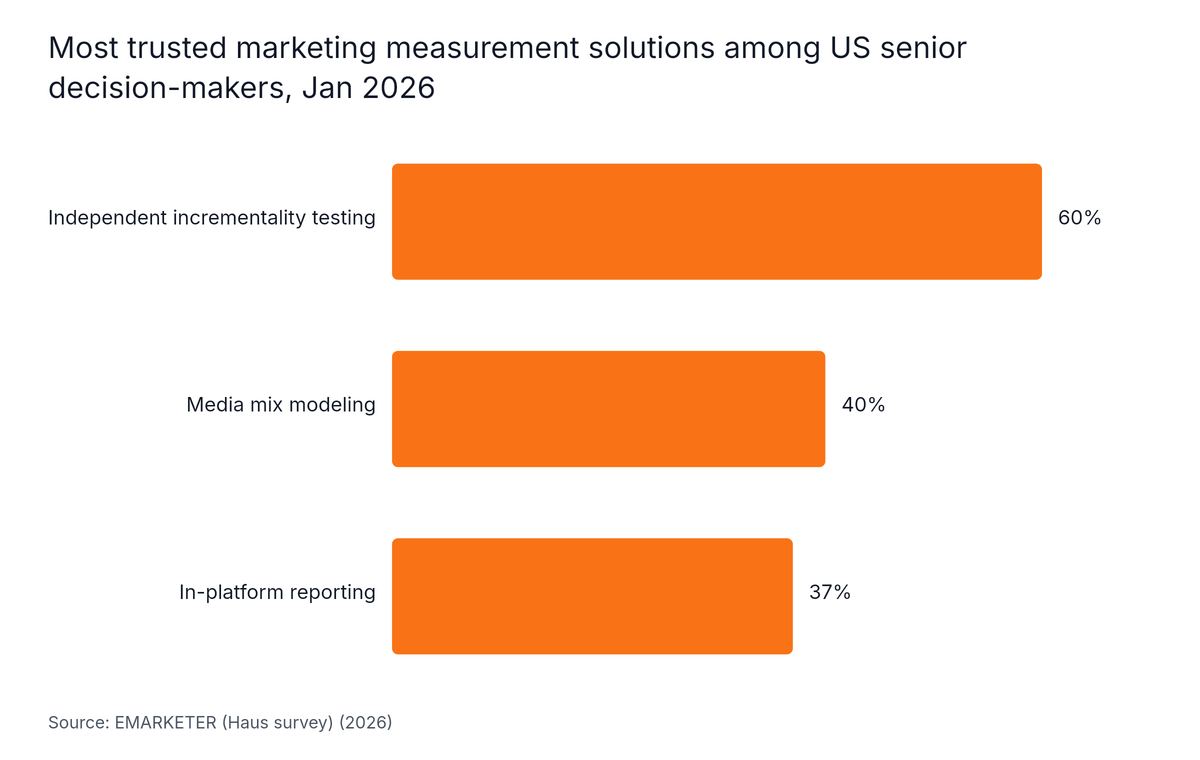
Trust follows the causal logic. In a January 2026 Haus survey, 60% of US senior decision-makers ranked independent incrementality testing as the most trusted measurement method, ahead of media mix modeling at 40% and in-platform reporting at 37% (EMARKETER, 2026). Haus sells incrementality testing, so treat the survey as vendor-commissioned.
Horizontal Bar chart: Most trusted marketing measurement solutions among US senior decision-makers, Jan 2026. Highest: Independent incrementality testing at 60%.
Neither survey is specific to B2B SaaS, and both cover US respondents only.
How Do B2B SaaS Teams Test Whether Spend Is Incremental?
Incrementality testing for B2B SaaS works by withholding a channel, such as branded search ads, from a holdout group, then comparing pipeline between the holdout and exposed groups over at least one full sales cycle. A holdout test is an experiment in which a selected group does not see a channel while another group does. Read results at opportunity or closed-won stage, not at form fill.
Two colleagues review a printed calendar timeline marked with a long holdout window.
A six-step holdout design
Pick one channel and one question. For example: does paid branded search add pipeline beyond organic results?
Fix tracking first. Store the GCLID with every lead, so exposed and holdout deals can be traced to closed-won.
Choose the readout stage. Opportunity or closed-won is the safest choice (see the table below).
Set the window. Run at least one median sales cycle plus CRM lag, using your own median cycle. For reference only, the median among the 104 audited accounts in GrowthSpree's June 2026 study was 84 days. That is not a B2B SaaS benchmark.
Split the audience. Use random account-level, audience or region holdouts, and keep other spend steady during the test.
Compare and report. Calculate pipeline per group, state lift as a range, and record the result as a calibration input for attribution.
Which stage should the readout use?
Stage
Speed of readout
Main risk
Form fill or marketing-qualified lead (MQL)
Fastest
Counts leads that never qualify
Sales-qualified lead (SQL)
Fast
Definitions differ between teams
Opportunity
Medium
Needs a written stage definition
Closed-won
Slowest
Too few deals for a clear result
Form fills are a weak readout.
From the research: GrowthSpree's June 2026 audit of 104 Google Ads accounts found that 78% of form fills never became an SQL. A separate GrowthSpree study of 1,412 ad variants across 96 accounts found cost per SQL tracked pipeline at a correlation of 0.71, against 0.09 for click-through rate.
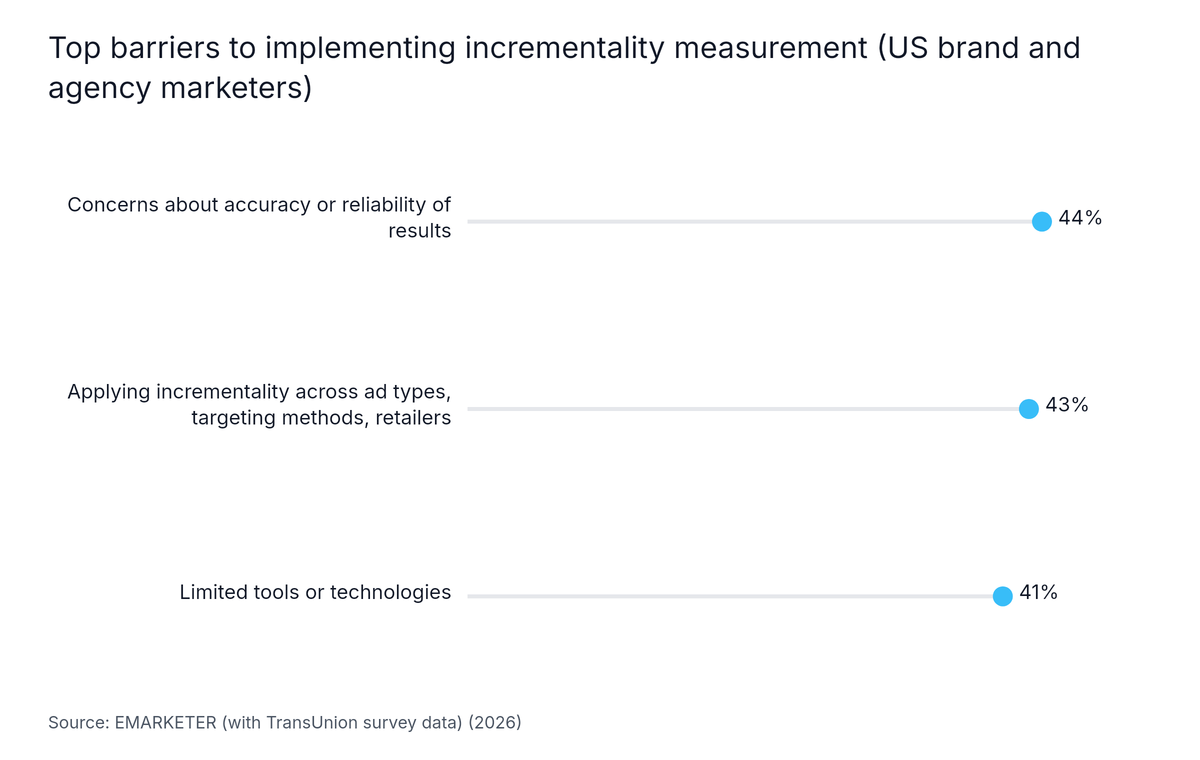
Measurement barriers are common. EMARKETER, citing July 2025 survey data, lists the top barriers to implementing incrementality as accuracy or reliability concerns (44%), applying it across ad types and targeting methods (43%) and limited tools (41%) (EMARKETER, 2026).
Lollipop chart: Top barriers to implementing incrementality measurement (US brand and agency marketers). Highest: Concerns about accuracy or reliability of results at 44%.
Low deal volume widens uncertainty. Read an earlier stage, lengthen the window, or test only the largest channel. Geo holdouts can also fit B2B poorly, because deals often concentrate in a few metro areas.
Why Do B2B SaaS Teams Need Both Incrementality and Attribution?
Incrementality testing and attribution are both needed in B2B SaaS because attribution gives fast, granular, always-on reporting, while incrementality testing gives the causal check on how much of that credit is real. Attribution guides weekly optimization; tests calibrate it. In a January 2026 Haus survey, 78% of US decision-makers said at least 10% of marketing spend is wasted because measurement is insufficient (EMARKETER, 2026).
A revenue operations analyst compares two printed reports side by side on a meeting table.
That survey is vendor-commissioned too. IAB's webinar framing is blunter. It describes "a measurement ecosystem that is fundamentally broken, shaped by privacy changes, fragmented proprietary platforms" (IAB, 2026). No single method fixes that, so the practical answer is to combine them.
Where media mix modeling fits
Media mix modeling (MMM) is a statistical model that estimates each channel's contribution to results using aggregate spend and outcome data. In the EMARKETER and TransUnion survey, US brand and agency marketers rated MMM the most reliable methodology at 27.6%, ahead of multi-touch attribution (19.4%) and unified measurement (18.9%) (EMARKETER, 2026). Incrementality testing was not an option in that question.
Method
Best question
Typical role for B2B SaaS
Attribution
Which campaigns and touches are tied to pipeline?
Weekly optimization inside channels
Incrementality testing
Did this channel cause extra pipeline?
Budget decisions and calibration
Media mix modeling
How should the whole budget be split?
Quarterly planning across channels
A simple calibration workflow
Run a holdout on one channel, such as branded search.
Compare the lift with the pipeline the CRM credits to that channel.
Record the gap as a calibration note for that channel.
Apply the note when reporting pipeline by source to finance, and rerun the test when spend or buyer behavior shifts.
Free tooling is growing. Google took the open-source Meridian GeoX library to general availability on September 9, 2026. It feeds geo-incrementality results into the Meridian MMM as calibration priors (Animo, 2026). It is geo-based and Google-centric, so it does not cover LinkedIn or account-level B2B tests on its own. Trade press has questioned whether advertisers will trust a platform to measure its own lift (Ad Measurement Weekly, 2026).
When Does Each Method Mislead, and Who Is This Not For?
Attribution misleads when it treats recorded touches as causes, and incrementality testing misleads when deal volume is too low or the sales cycle too long for a clean readout. In a telecom geo-lift test by Objective Platform, pausing branded search cut revenue by 26.2% (Objective Platform, 2026), so branded search is not always wasted.
A finance partner and a marketing leader talk across a table with an open notebook between them.
That case is a counter-example. Pausing branded search in test regions cut revenue from €385,000 (active) to €310,000 (paused), a single vendor case study that is not B2B SaaS. Branded search can be incremental when rivals compete for the brand term. It can also be mostly captured demand. Only a test of the specific account can say which.
No credible published B2B SaaS benchmark for branded search incrementality was found. Teams should measure their own result rather than rely on unsourced claims that branded search is mostly wasted.
Who this approach is not for
Teams with no CRM or no sales team. Without opportunity records there is nothing to read out.
Teams that cannot store click IDs yet. Fix tracking before any test.
Teams with very few deals per quarter. Results will carry wide ranges, so use them as direction, not proof.
Teams seeking one number. Attribution, incrementality and MMM disagree by design, and revenue operations (RevOps) owns the reconciliation.
Frequently Asked Questions
How long should a B2B incrementality test run when the sales cycle is long?
A B2B incrementality test should run for at least one median sales cycle plus the delay before deals reach the CRM. Use your own median cycle. Among 104 audited Google Ads accounts the median was 84 days (GrowthSpree, June 2026), a reference point rather than a B2B SaaS benchmark.
Can B2B SaaS teams with low deal volume run incrementality tests?
Teams with low deal volume can run incrementality tests, but the results carry wider uncertainty. Options include reading an earlier stage such as opportunities, lengthening the holdout window, and testing only the largest channel. Closed-won deals alone are often too few for a clear result, so report lift as a range.
Should I measure incrementality at the lead, opportunity or closed-won stage?
For B2B SaaS, measure incrementality at the opportunity or closed-won stage, because form fills and leads often never qualify. Closed-won is the most accurate but slowest and needs enough deals. Opportunity is a practical compromise when volume is low, provided the stage has a written definition.
How do I use incrementality results to calibrate my attribution model?
Compare the lift from a holdout test with the pipeline the CRM credits to the same channel, then record the gap as a calibration note for that channel. Apply the note when reporting pipeline by source, and rerun the test when spend or buyer behavior changes.
What is a geo holdout test and does it work for B2B?
A geo holdout test turns a channel off in selected regions and compares results with regions where it stays on. It can work for B2B SaaS, but deals often concentrate in a few metro areas, which makes clean region matching harder. Account-level or audience holdouts are common alternatives.
What Should B2B SaaS Teams Do Next?
B2B SaaS teams should keep attribution for weekly optimization, store click IDs in the CRM, and run one holdout test on a single channel, such as branded search, for at least one median sales cycle plus CRM lag. They should then use the measured lift to calibrate the attribution view that finance sees.
Interest in testing is growing: 36.2% of US brand and agency marketers plan to increase incrementality spending over the next 12 months (EMARKETER, 2026). Five points matter most:
Last-touch reporting over-credits branded search when buyers already prefer the vendor.
Store click IDs in the CRM before any test.
Run holdouts for at least one sales cycle plus CRM lag, and read at opportunity or closed-won.
Use test results to calibrate attribution, and say plainly when no benchmark exists.
Start with the attribution models overview to choose the always-on model, then pick one channel to test. To design the first holdout, Meet with an expert for a free consultation.
Written by
Ishan Manchanda
Ishan Manchanda is co-founder of GrowthSpree, a B2B SaaS marketing consultancy founded in 2017 that has managed $60M+ in ad spend across 300+ B2B SaaS companies. He focuses on demand generation, go-to-market strategy and pipeline growth, and has been featured in Silicon Valley Times, SaaS Mag and the Unbounce podcast.
 Ishan ManchandaNov 17, 2026