Blog
Conversion Path: What It Is and How to Track One Across a Long B2B Sales Cycle
A conversion path is the sequence of touches before a deal converts. See where click IDs expire and how to track a B2B SaaS path across a widely cited 84-day cycle.
What's the best lead routing software? Compare tools on seven criteria G2 ratings miss: rule editing, audit logs, SLAs, matching, CRM fit and cost.
 Ishan ManchandaNov 23, 2026
A conversion path is the sequence of touches before a deal converts. See where click IDs expire and how to track a B2B SaaS path across a widely cited 84-day cycle.

A customer lifecycle model for B2B SaaS: ten stages with entry criteria, triggers, CRM fields and owners, plus how RevOps keeps one number across teams.

ROAS definition, how ROAS differs from ROI, and why platform ROAS rarely matches closed-won revenue in B2B SaaS paid search, with a metric-by-audience guide.
Request a quote and our experts will contact you within 24 hours with tailored solutions and pricing.
RevOps for B2B SaaS
Last updated: Nov 23, 2026
By RevOps for B2B SaaS Editorial Team. Last updated: November 4, 2026.
The best lead routing software is the tool that lets a revenue operations (RevOps) manager edit assignment rules without an engineer, matches leads to accounts accurately, and fits the existing stack, not the tool with the highest review score. The answer depends on criteria that star ratings hide. Average B2B lead response time is 47 hours across 939 companies, and only 23% respond within five minutes (Optifai, 2026). Routing rules, ownership and timers decide whether that gap closes. This guide gives B2B SaaS buyers a vendor-neutral framework, a stack build order and a shortlist method. For a shorter primer, read lead routing software for B2B SaaS.
Key Takeaways
- Lead routing software should be chosen on who can edit rules, change speed, audit logs, SLA enforcement, matching depth, CRM fit and total cost, because review ratings do not separate leading tools.
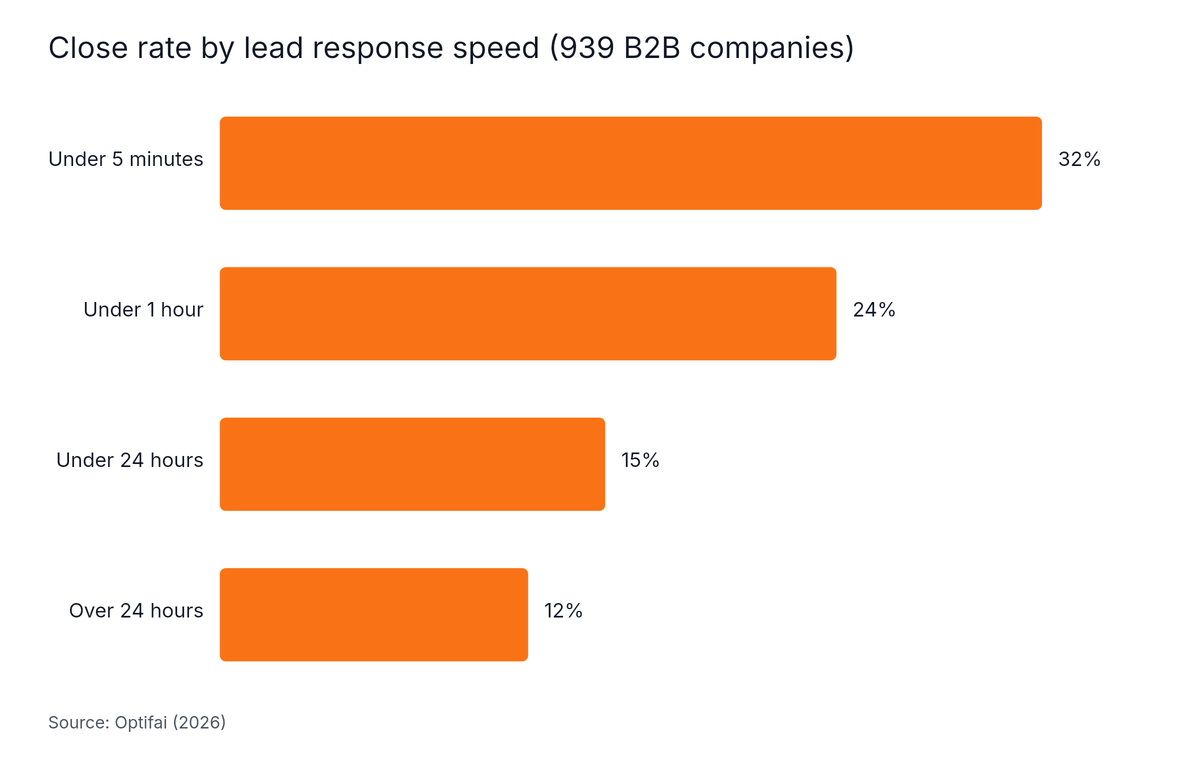
- Routing speed has a measurable payoff: a 2026 vendor benchmark of 939 B2B companies shows a 32% close rate under five minutes versus 12% after 24 hours.
- A first CRM rebuild in B2B SaaS should build definitions, CRM, data hygiene, routing, attribution and reporting in that order.
- Revenue attribution tools should be compared on type (CRM-native, purpose-built, warehouse-native) and account-level reporting, not on vendor rankings.
- No vendor is recommended by default here: the shortlist method is to pick one tool per category and score all on the same written criteria.
There is no single best lead routing software for every B2B SaaS team. Lead routing software is a tool that assigns inbound leads to the right owner using rules, account matching and response timers. The best choice is the one that a RevOps manager can edit without an engineer, that connects to the existing customer relationship management (CRM) system, and that fits the total budget.

Speed to lead is the time between a lead's form fill and the first sales activity on that lead. Optifai, a vendor that published a benchmark of 939 B2B companies covering Q2 2025 to Q1 2026, reports a 32% close rate for leads contacted in under five minutes versus 12% after 24 or more hours (Optifai, 2026). Treat it as a vendor benchmark, not an independent study. The chart shows the full drop by response window, and it is steady, not sudden.
Source: Optifai, 2026
A Forrester survey found that 92% of B2B buyers start with at least one vendor already in mind (Digital Commerce 360, reporting Forrester, 2025). Forrester's summary line was "B2B buying today is a process of confirmation, not selection," (Digital Commerce 360, 2025). A slow or misrouted reply to a demo request costs more when the buyer has already chosen a favorite.
Separately, 67% of B2B buyers prefer a rep-free purchase experience, according to a Gartner survey of 646 buyers run in August and September 2025 (Digital Commerce 360, reporting Gartner, 2026). The form fill or demo request may be the only seller touch that routing controls.
Follow these steps before opening any vendor page:
Several lead routing tools look alike on G2 because review scores measure satisfaction, not fit. Seven criteria separate them in practice for a B2B SaaS team: who can edit rules, how fast a change ships, audit logs, SLA enforcement, lead-to-account matching depth, CRM fit and total cost. G2 reports that 51% of buyers now start software research with an AI chatbot (G2, 2026).

The table below turns the seven criteria into questions a RevOps manager can ask on a vendor call.
| Criterion | Question to ask | Why it separates tools |
|---|---|---|
| Who edits rules | Can a RevOps admin change assignment logic without an engineer or a ticket? | Decides whether rules stay locked in code |
| Change velocity | How long from deciding on a rule to it going live? | Slow changes leave leads in a queue |
| Audit logs and rollback | Are rule changes logged and reversible? | Explains why a lead went to the wrong owner |
| SLA enforcement | Does a timer reassign a lead when no one acts? | Protects response time after hours |
| Matching depth | Does the tool match leads to accounts and handle duplicates? | Misrouting often starts with bad matching |
| CRM fit | Is it native to one CRM or CRM-neutral? | Affects roadmap independence |
| Total cost | What do seats, plan tier and add-ons add up to? | Published prices vary widely |
Lead-to-account matching is the process of linking a new lead to an existing account record so the account owner receives it. It depends on clean data, and 75% of RevOps professionals cite data inconsistencies as their most frustrating stack problem (MarketingOps.com, 2025).
An SLA timer is a rule that reassigns or escalates a lead when no one acts within a set time. LeanData's Q2 2026 release, for example, added unified audit logs and a Track SLA node (LeanData, 2026). That is a vendor-published example of what to look for, not an endorsement. Reporting on assignment latency belongs on the shared RevOps reporting dashboard.
Published prices checked in October 2026 range from $20 per user per month for Distribution Engine Starter to $15,000 a year for Chili Piper's Routing and Scheduling plan with 15 seats, while LeanData does not publish prices (Growigami, 2026). The source is a trade comparison whose independence is unverified, so re-check each vendor's pricing page before budgeting.
| Example tool | Published price | Note |
|---|---|---|
| Distribution Engine Starter | $20 per user per month | Per-seat pricing |
| Chili Piper Routing and Scheduling | $15,000 a year for 15 seats | Annual plan |
| LeanData | Not published | Quote only |
G2 reports that 69% of buyers changed vendor because of a chatbot recommendation, and that chatbots now rank above review sites as a shortlist influence (G2, 2026). A G2 executive put it this way: "What worked last year won’t work now, as AI has disrupted every part of the buying process." (SalesTechStar, reprinting a G2 release, 2025). Written criteria hold up better than a star score.
A modern revenue operations software stack for a first CRM rebuild in 2026 needs six layers built in order: shared definitions, the CRM, data hygiene and matching, routing, attribution, and reporting. Data comes first because 75% of RevOps professionals cite data inconsistencies as the most frustrating part of their stack (MarketingOps.com, 2025).

Stage definitions are written entry criteria for each lifecycle stage, tied to buyer actions. They come before any tool, because routing rules that reference an undefined stage get hard-coded again. The build order below shows what each layer does and what breaks when it is skipped.
| Order | Layer | Job | What breaks if skipped |
|---|---|---|---|
| 1 | Definitions and ownership | Stage definitions, owner model, SLA targets | Marketing and sales count different leads |
| 2 | CRM | One system of record for leads, contacts, accounts | Spreadsheets drift |
| 3 | Data hygiene and matching | Dedupe, field standards, lead-to-account matching | Routing assigns to the wrong owner |
| 4 | Routing | Assign, time and escalate inbound leads | Demo requests sit in a queue |
| 5 | Attribution | Credit pipeline to touches | Budget follows the last touch |
| 6 | Reporting | One report both teams use | Board numbers need hand reconciling |
The average RevOps tech stack has 11 tools, and 53% of practitioners prefer custom-built tools over specialized software, based on a survey of 180 professionals across 28 countries (Revenue Wizards, 2025). The survey authors' own takeaway was short: "More tools aren't always better." (Revenue Wizards, 2025). Add a tool only when a named job in the table above has no owner.
For a longer view of what each layer covers, see revenue operations software: what the stack covers.
The best revenue operations software to evaluate after Series A is whichever tool fixes the failure point an audit finds first, not a full platform bundle. Nearly half of RevOps professionals, 47%, rate their stack's ROI as average or worse (MarketingOps.com, 2025), so each tool should earn its place against a named job.

The study authors state it plainly: "Nearly half (47%) of RevOps professionals rate their stack's ROI as average or worse." (MarketingOps.com, 2025).
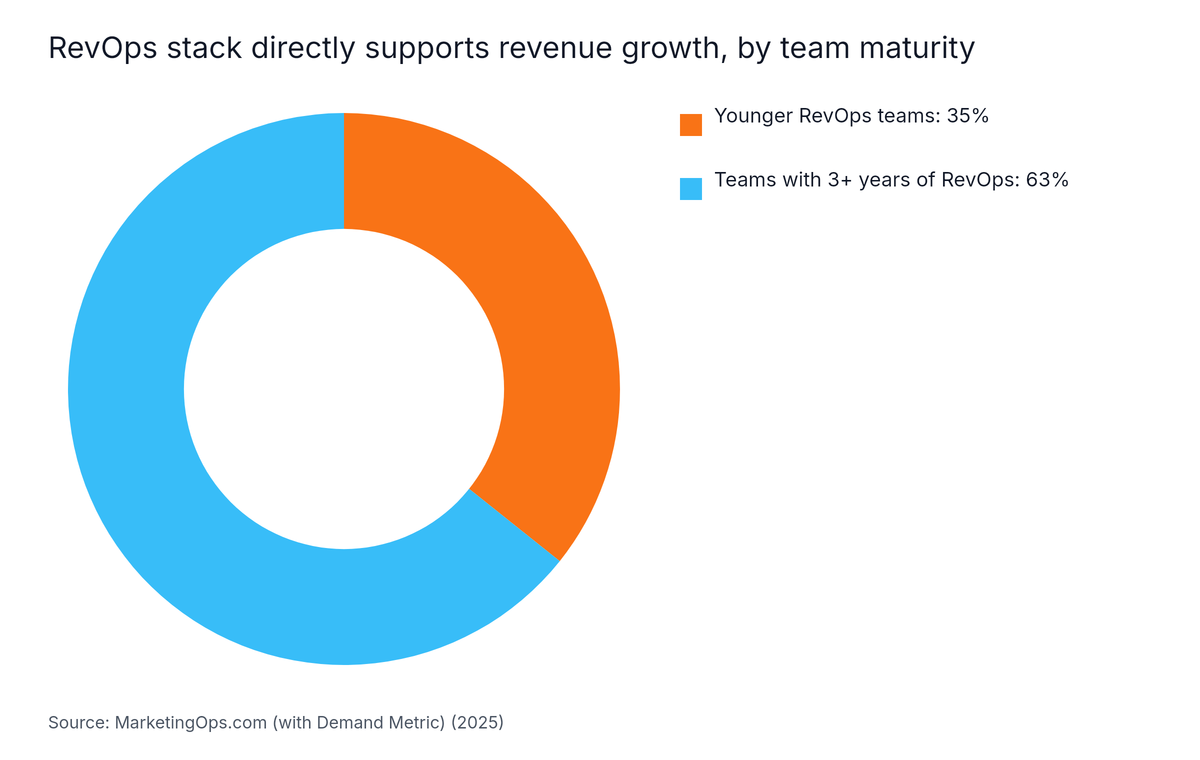
Yes. Among respondents on teams with three or more years of RevOps, 63% say their stack directly supports revenue growth, versus 35% in younger teams (MarketingOps.com, 2025). Younger teams gain more from fixing definitions and data than from adding software.
Source: MarketingOps.com (with Demand Metric), 2025
Vendor consolidation also matters for CRM-neutral shortlists. Salesforce completed its acquisition of Qualified on April 1, 2026 (MarketScreener, 2026). Teams not committed to one CRM should ask each vendor about roadmap independence.
Revenue attribution tools worth evaluating for a B2B SaaS stack fall into three types: CRM-native, purpose-built, and warehouse-native. Revenue attribution tools are software that credits pipeline and closed-won revenue to the marketing and sales touches behind it. Buying groups matter here: 73% of purchases involve three or more departments (Forrester, 2026), so account-level reporting is a core test.

| Type | What to check | Typical fit |
|---|---|---|
| CRM-native | Does it report at account level and keep source fields after assignment? | Small teams on one CRM |
| Purpose-built | Does it ingest ad, web and CRM data without custom work? | Teams with several paid channels |
| Warehouse-native | Who maintains the models, and is an analyst available? | Teams with data engineering support |
The table lists selection criteria, not vendor claims. Verify each product against its own documentation. A deeper evaluation list is in marketing attribution software for B2B SaaS, and the model choices are in attribution models in B2B marketing.
No verified ranking shows which revenue attribution tools teams choose most in 2026. The evidence points to a change in buyer behavior instead: 94% of B2B buyers now use AI in the buying process, up from 89% a year earlier (Forrester, 2026). Forrester expects that "Buyers will spend more and more of their buying process with AI answer engines and less time engaging directly with vendors." (Forrester, 2026).
Research that happens outside trackable channels leaves gaps in click data. A self-reported "how did you hear about us" field covers part of that gap. A published range with no stated method rates single-model attribution at 38% to 58% accuracy and a hybrid of multi-touch, self-reported and branded search lift at 82% to 92%. Treat that range as opinion, not a finding. For the single-touch problem, see last-touch attribution in B2B SaaS.
Click data breaks in practice, too. In "The 2026 B2B SaaS Google Ads Waste Report" (GrowthSpree, June 2026), covering 104 Google Ads accounts and $78.0M in spend, 91% of accounts had no Google click ID (GCLID) reaching the CRM. After a 90-day attribution fix, the share of closed-won deals traced to a campaign rose from 0% to 67%.
Routing and attribution connect at one point: the source and campaign fields must survive assignment. How ad click tracking breaks between the ad platform and the CRM explains the fix.
Lead routing platforms worth evaluating in 2026 fall into three groups: CRM-native routing such as HubSpot workflows and Salesforce Flow, dedicated routing and matching tools such as LeanData, and routing-plus-scheduling tools such as Chili Piper. Shortlist one from each group, then score all three on the same criteria. Only 11% of organizations have built AI for routing and assignment (LeanData, citing LXA, 2026).
That 11% figure comes from a routing vendor citing a co-published report with no stated sample, so read it as directional. Most teams still run rules-based routing, and round robin is an assignment method that hands each new lead to the next rep in a rotation.
| Group | Example tools | Check before buying |
|---|---|---|
| CRM-native | HubSpot workflows, Salesforce Flow | Does the rule builder cover your distribution and availability needs? |
| Dedicated routing and matching | LeanData | Audit logs, SLA nodes, matching depth, quote-based cost |
| Routing plus scheduling | Chili Piper | Booking on the form, plan price for your seat count |
Examples are illustrative, not ranked or recommended. Confirm features in each vendor's current documentation.
Look for visual or plain-language builders. LeanData's Q3 2026 release, published August 24, 2026, made AI Inference Nodes generally available and added an AI Assistant for building and troubleshooting FlowBuilder graphs in plain language (LeanData, 2026). An agency recap of HubSpot's October 2026 update reports that distribution models (Round Robin, Balanced, Random) and user availability were added to the "Rotate record to owner" workflow action for the Leads object (BBD Boom, 2026). Confirm that recap in HubSpot's release notes.
Rule patterns matter more than brand names. A workable pattern:
Account-level logic helps because 73% of purchases involve three or more departments, averaging 13 people inside the buyer's organization and nine outside (Forrester, 2026). LeanData's AI Inference Node is one vendor example of classifying job titles into persona categories.
Three handoff patterns exist: native (scoring and routing in one product), CRM-owned fields (scoring writes a field that routing reads), and API or webhook. Among respondents who say their tools don't integrate well, only 20% are satisfied with their stack (MarketingOps.com, 2025). Sourced vendor detail on these patterns is thin, so ask each vendor which pattern it uses and test it with sample leads.
Choose a tool whose rules a RevOps manager can edit alone, and start with CRM-native routing if the logic is simple. Add a dedicated tool when matching, SLA timers or audit logs become the bottleneck.
The lead routing software comparison framework is not for teams that have no sales team and no CRM yet, and it does not rank vendors, price tools beyond published figures, or give legal advice on consent. Several figures come from vendor-run sources, such as the 939-company Optifai benchmark (Optifai, 2026), so each is labeled with its source and method.
Further limits to keep in mind:
Lead routing software worth evaluating in 2026 falls into three groups: CRM-native routing such as HubSpot workflows and Salesforce Flow, dedicated routing tools such as LeanData, and routing-plus-scheduling tools such as Chili Piper. Evaluate one from each group against the same criteria: rule editing, audit logs, SLA timers, matching depth, CRM fit and total cost.
Lead routing tools with visual or plain-language builders let RevOps change complex assignment rules without an engineer. LeanData's August 2026 release added an AI Assistant for building and troubleshooting FlowBuilder graphs in plain language, and HubSpot's October 2026 update added distribution models to its lead rotation workflow action. Confirm current capability in each vendor's documentation before buying.
Lead scoring and routing tools work together without a custom integration when scoring writes to a standard CRM field that the routing tool reads, or when both sit in one product. Among respondents whose tools integrate poorly, only 20% are satisfied with their stack (MarketingOps.com, 2025). Ask each vendor which handoff pattern it uses: native, CRM-owned field, or API and webhook.
Lead routing tools handle three product lines by branching on a product-interest field and a persona field, then sending each branch to a separate owner pool with a fallback. LeanData's AI Inference Node, generally available since August 2026, classifies messy job titles into persona categories. Confirm in vendor documentation that each tool supports multi-branch rules before shortlisting.
No lead routing software wins on reviews alone, because review scores cluster narrowly across leading tools and buyers increasingly shortlist elsewhere. G2 reports that 51% of B2B software buyers now start research with an AI chatbot more often than Google, up from 29% in April 2025 (G2, 2026). Use reviews to screen for support quality, then decide on criteria.
A Series A SaaS team without a dedicated ops engineer should shortlist tools whose rules a RevOps manager can edit in a visual or plain-language builder, and start with CRM-native routing if the rules are simple. Published routing prices checked in October 2026 range from $20 per user per month to $15,000 a year for 15 seats (Growigami, 2026).
A comparison of lead scoring and routing software should cover seven things: who edits rules, time to change a rule, audit logs, SLA enforcement, lead-to-account matching, CRM fit and total cost. Add the scoring-to-routing handoff, reporting on assignment latency and the vendor's roadmap independence. A written scorecard lets a new RevOps hire audit the decision rather than inherit it.
No verified ranking shows which lead routing software revenue operations teams reference most. Mention counts reflect marketing effort as much as real use. A better test is a peer check in practitioner communities such as RevOps Co-op or RevGenius, using the same written criteria for every tool on the shortlist.
The best lead routing software is the one that passes a written test, not the one with the best star rating. Five takeaways:
Next step: bring the shortlist and your current routing rules to a free call. Meet with an expert.
Written by
Ishan Manchanda
Ishan Manchanda is co-founder of GrowthSpree, a B2B SaaS marketing consultancy founded in 2017 that has managed $60M+ in ad spend across 300+ B2B SaaS companies. He focuses on demand generation, go-to-market strategy and pipeline growth, and has been featured in Silicon Valley Times, SaaS Mag and the Unbounce podcast.