Request a quote and our experts will contact you within 24 hours with tailored solutions and pricing.
Attribution Window in Paid Media: What It Is and How to Set One for B2B SaaS
An attribution window is the number of days after an ad click or view in which an ad platform can claim credit for a conversion, and in B2B SaaS the default setting is almost always shorter than the deal. Dreamdata's 2026 benchmark puts the average journey at 272 days. A 7-day or 30-day window sees a sliver of it. The result is pipeline reporting that rewards the last touch and hides the campaigns that started the deal. This guide defines the attribution window, shows how platform defaults differ from what the customer relationship management (CRM) system records, and gives a repeatable method for choosing a window that fits your own deal velocity.
Key Takeaways
An attribution window is the number of days after an ad interaction in which a platform can credit that ad for a conversion.
Platform defaults are short and per-platform, while the CRM records the full deal, so the two systems report different pipeline.
Dreamdata's 2026 report puts the average B2B journey, first tracked touch to close, at 272 days, up from 211 days.
The right window comes from your own closed-won history, set near the 75th to 90th percentile for each segment and conversion event.
Document every window change with a date, and never compare trends across the change.
What is an attribution window in paid media reporting?
An attribution window is the number of days after an ad interaction during which an ad platform can credit that ad for a conversion. If a buyer converts inside the window, the campaign gets the credit; one day later, the platform records nothing. Meta has kept only a 1-day view window since January 12, 2026 (PPC Land, 2025), so the setting alone changes reported results without changing a sale.
Timeline of a long B2B deal with early touches falling outside a short credit window
Attribution window, lookback window and conversion window
Most platforms use these terms loosely. The table separates the ideas that matter for B2B SaaS reporting.
Term
Meaning
Why it matters in B2B SaaS
Attribution window is the days after an interaction in which credit can be given
Often called a lookback window
Sets which touches a platform can see
Lookback window is the period a platform searches backward from a conversion
Same setting, seen from the conversion's side
Limits how early a campaign can be credited
Click-through attribution is credit given when a conversion follows a click
Applies to clicks only
The main signal for paid search and LinkedIn
View-through attribution is credit given when a conversion follows an impression with no click
Applies to views only
Often shorter and easier to over-credit
A window is not an attribution model. The window decides which touches are eligible. The model decides how credit is split among them. For the model question, see attribution models in B2B marketing.
How do platform default windows differ from what the CRM sees?
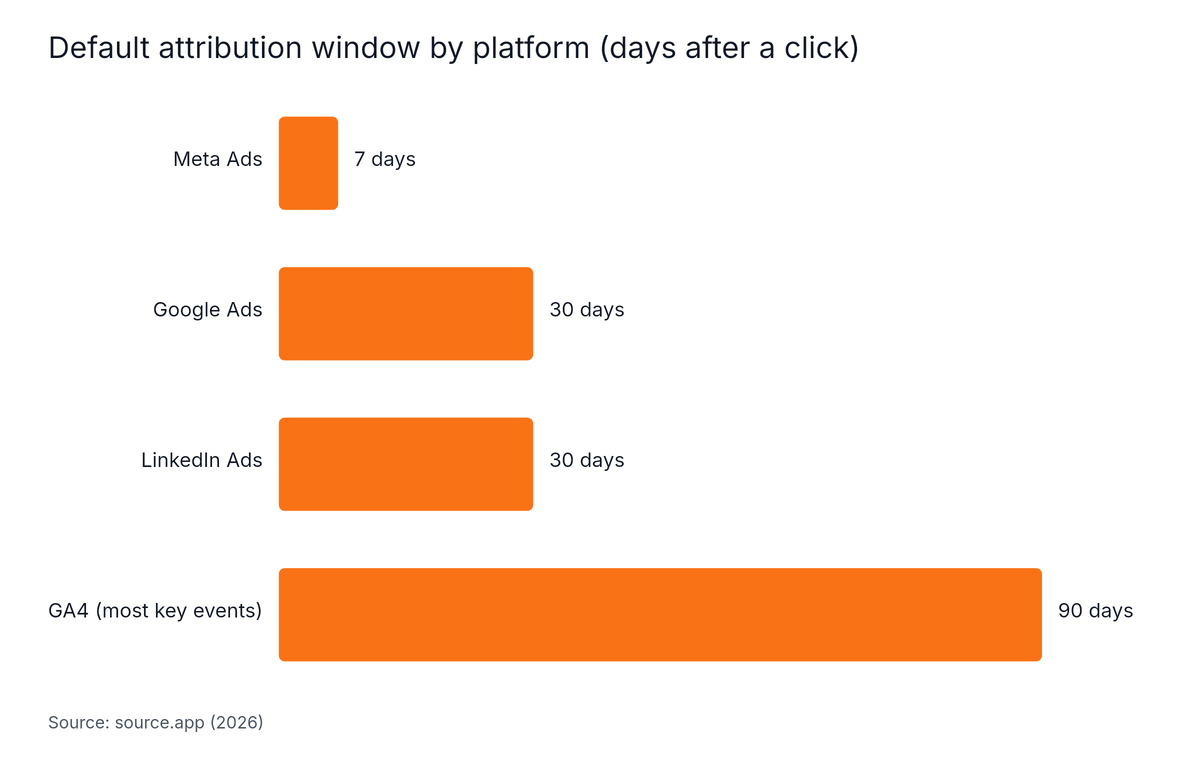
Platform attribution windows are short, fixed per platform, and limited to that platform's own touches: 7 days for Meta, 30 for Google Ads and LinkedIn, and 90 for most Google Analytics 4 (GA4) key events, according to source.app (2026). A customer relationship management (CRM) system records the whole deal, so it sees every touch regardless of any window.
Horizontal Bar chart: Default attribution window by platform (days after a click). Highest: GA4 (most key events) at 90 days.
LinkedIn's documentation says: "The Conversions API now allows you to set a 365-day conversion lookback window" (Microsoft Learn, 2025). Sources disagree on the exact lookback options in the Revenue Attribution Report, so check Campaign Manager for the current list.
What changed at Meta in 2026
Meta removed the 7-day view and 28-day view windows from the Ads Insights API on January 12, 2026, leaving 1-day view as the only view-through window (PPC Land, 2025 report). A March 3, 2026 announcement limited click-through attribution for website and in-store conversions to link clicks, with a staggered rollout (Zenko Protocol, 2026). Both come from trade sources, so confirm them in Meta's documentation. Meta reports from 2025 and 2026 are not like-for-like.
Two separate data streams that disagree, one short and one long, representing platform and CRM views
Why the CRM and the platform disagree
The CRM tracks a deal from first known touch to closed-won. Each ad platform sees only its own interactions inside its own window, and each may claim the same deal. Without a stored click ID, the CRM cannot confirm which campaign a platform is claiming.
Our data: In a GrowthSpree study of 104 Google Ads accounts and $78.0M in spend (June 2026), 91% had no Google click ID (GCLID) reaching the CRM, 89% ran default attribution, and 78% of form fills never became a sales-qualified lead (SQL).
Why does a 7-day or 30-day window miss most touches in a B2B SaaS sales cycle?
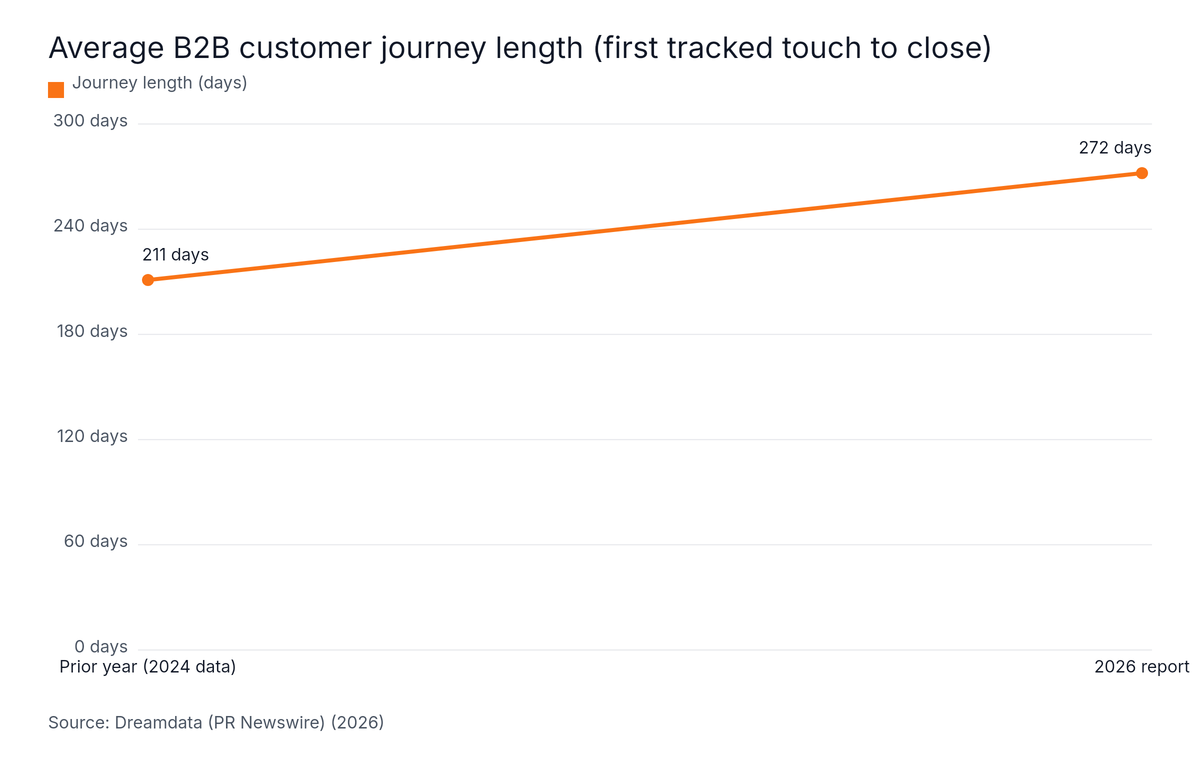
A 7-day or 30-day attribution window misses most touches in B2B SaaS because the average journey from first tracked touch to close now runs 272 days, up from 211 days, according to Dreamdata's 2026 benchmark report. Campaigns that open the conversation fall outside the window, so credit shifts toward whatever touched the buyer last.
Line chart: Average B2B customer journey length (first tracked touch to close). Highest: 2026 report at 272 days.
The report's dataset covers over 66 million sessions across 3.5 million customer journeys, and Dreamdata is an attribution vendor, so treat it as vendor research. It states: "B2B marketers now own 81% of the full buyer journey, which has extended from 211 days to 272 days." (Dreamdata via PR Newswire, 2026).
More people, more channels, more touches
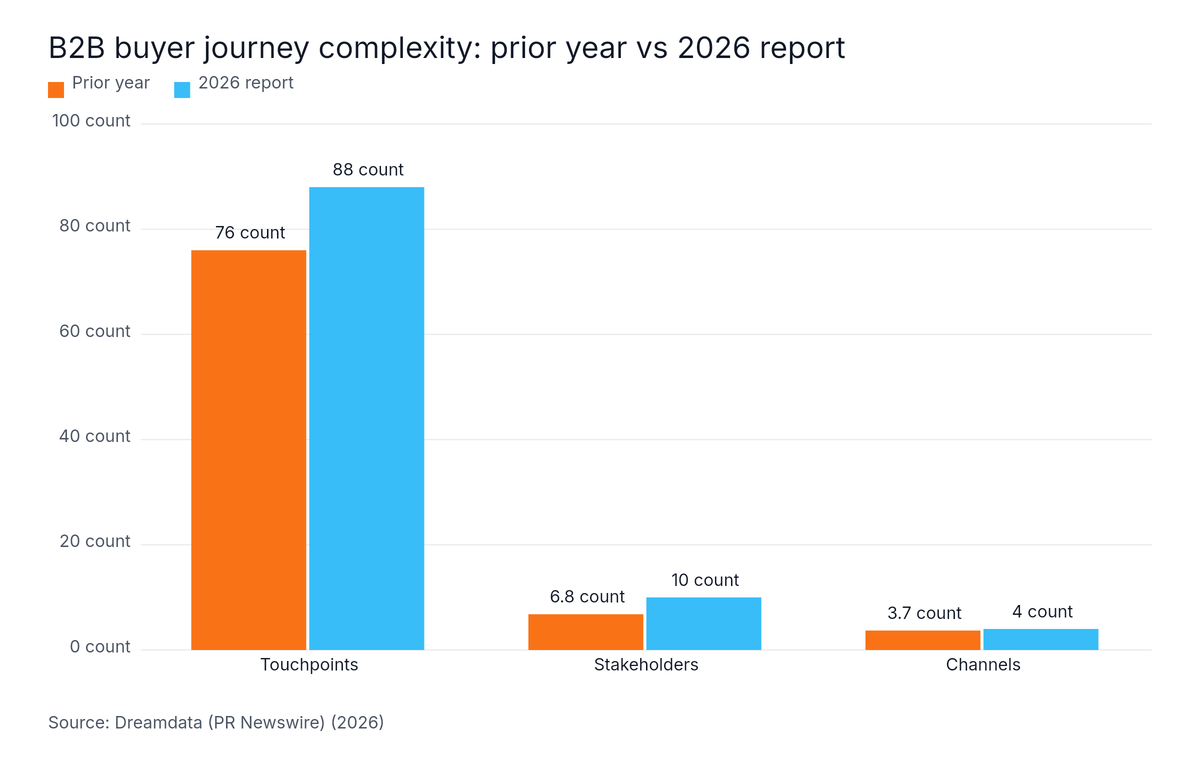
The same report counts 88 touchpoints per journey (up from 76), 4 channels (up from 3.7) and 10 stakeholders (up from 6.8). A window must cover several people across several channels, not one click.
Grouped Bar chart: B2B buyer journey complexity: prior year vs 2026 report. Highest: Touchpoints at 76 count.
The 84-day figure often quoted for B2B SaaS and the 272-day figure measure different things. Optifai reports a median of 84 days for opportunity-to-close in B2B SaaS, from a study of 939 companies (Optifai, 2026). Another Optifai page gives a different average from the same study, so read it as a median as reported by Optifai. Dreamdata's 272 days starts at the first tracked touch. A window anchored to opportunity creation needs fewer days than one anchored to closed-won.
How credit compresses
When early touches fall outside the window, branded search and retargeting get the credit. That is the pattern described in last-touch attribution. A GrowthSpree study of 104 Google Ads accounts (June 2026) found that 78% of form fills never became a sales-qualified lead, so a short window also rewards cheap form fills over pipeline.
How do you set an attribution window for a B2B SaaS funnel?
To set an attribution window for a B2B SaaS funnel, measure how many days your closed-won deals took from first known touch to opportunity creation and to close, then set the window near the 75th to 90th percentile for each segment. Use your own CRM distribution, not a published median, and document the choice with a change date.
A ruler-like scale marking percentile points along a stream of deal markers
The 90th percentile (p90) is the number of days within which 90% of your deals reached a given milestone. It protects against the long deals a median ignores. Follow these steps.
Pick the anchor event. Decide whether the window must reach opportunity creation, SQL or closed-won. Report each separately.
Export closed-won deals. Include first known touch date, opportunity created date, close date, deal size and deal type (new or expansion).
Calculate the days. Compute first touch to opportunity creation, and first touch to close, for every deal.
Find the percentiles. Calculate the median, 75th and 90th percentile for each segment. Segment by contract size, because Optifai's study splits cycles by deal size.
Set the window. Use the 75th percentile as a floor and the 90th as a ceiling, then cap it at what the platform allows.
Use the CRM past the ceiling. If your journey exceeds a platform's maximum, send click IDs and qualified stages to the CRM and report from there. The GCLID is the parameter Google Ads appends to the landing page URL to identify the ad click.
Write it down. Record the window, the date and the reason, and annotate dashboards.
Match the window to the event
Use different windows for different conversion events. A shorter window fits a demo or trial form fill, a longer one fits a marketing-qualified lead (MQL) or SQL import, and the longest fits closed-won.
Optifai reports that sales cycles are 22% longer since 2022, so a window sized years ago is likely stale (Optifai, 2026). Recompute from your own CRM at least once a year, and sooner after a platform changes its rules.
What mistakes should you avoid when changing an attribution window?
The most common attribution window mistakes are comparing trends across a window change, lengthening a window without reconciling to CRM pipeline, and using one window for every conversion event. Sales cycles are 22% longer since 2022 per Optifai (2026), so stale windows drift further from reality. The fixes are annotation, monthly reconciliation and event-specific windows.
Three stacked lanes of different lengths representing windows for different conversion events
Mistake
Why it happens
Fix
Comparing numbers across a window change
Changes usually apply forward only
Log the change date and annotate dashboards
Lengthening the window without a check
Longer windows let platforms claim the same deal
Reconcile platform pipeline to CRM pipeline monthly
One window for every event
Account-level defaults are easy to leave alone
Set windows per conversion event
Reading Meta 2025 against 2026
Meta removed windows and narrowed click credit in 2026
Treat 2026 as a new baseline
Guardrails against over-crediting
Each platform can claim the same deal, so the sum of platform pipeline can exceed the CRM's. A monthly reconciliation of platform pipeline against CRM pipeline catches this. For the choice of model on top of the window, see marketing attribution models.
One result to expect
In a GrowthSpree study of 104 Google Ads accounts (June 2026), the share of closed-won deals traced to a campaign went from 0% to 67% after a 90-day attribution fix. The fix centered on getting click IDs and qualified stages into the CRM, not on the window alone. For tooling that automates this, see marketing attribution software for B2B SaaS.
What are the limits of an attribution window?
An attribution window cannot fix missing data, prove causation, or settle which channel deserves budget. It only controls how long a platform credits an interaction, and the average B2B journey already runs 272 days (Dreamdata, 2026), beyond most in-platform ceilings. If the click ID never reaches the CRM, a longer window adds little and may inflate credit.
A single thin line of light stopping at a boundary while a wider path continues beyond it
It is not a model. Credit splitting is a separate decision.
It is not proof. Credit inside a window is not the same as lift. Holdout or incrementality tests answer that.
It cannot reach beyond the platform. A journey of 272 days on average exceeds most default windows, so the CRM must be the system of record.
Benchmarks vary. Cycle lengths differ by definition and source, so use your own CRM data and treat published figures as a range.
It is not for B2C. This guide applies to B2B SaaS teams with a sales team and a CRM.
Frequently Asked Questions
Is an attribution window the same as a lookback window?
In most ad platforms, yes. Attribution window, lookback window and conversion window all describe the number of days after an ad interaction in which a conversion can be credited to that ad. Platforms use the terms loosely, so check the setting name and whether it applies to clicks, views or both.
Does changing an attribution window change historical data?
Usually no. Window changes in ad platforms generally apply going forward, so earlier reports keep the window that was active when they were recorded. Log the change date, annotate dashboards, and avoid comparing trends across the change. Confirm the behavior in the platform's help pages before relying on it.
Can a longer attribution window over-credit ads?
Yes. A longer attribution window gives each platform more time to claim the same deal, so the sum of platform-reported pipeline can exceed what the CRM records. Reconcile platform-reported pipeline against CRM pipeline each month, and use holdout or incrementality tests where the stakes justify them.
What did Meta change about attribution windows in 2026?
Meta removed the 7-day view and 28-day view windows from its Ads Insights API on January 12, 2026, leaving 1-day view plus 1-, 7- and 28-day click, according to PPC Land. A March 2026 announcement also limited click-through attribution to link clicks. Verify current options in Meta's own documentation.
How long should a B2B SaaS attribution window be?
A B2B SaaS attribution window should match your own closed-won deal history, typically set near the 75th to 90th percentile of days from first known touch to the conversion event you report on. Published medians vary by source and definition, so a CRM export of your own deals is the better guide.
Conclusion
An attribution window decides which touches a platform can see, and default settings were not built for long B2B SaaS cycles. The practical steps are short.
Define the window as days of credit, separate from the attribution model.
Expect platform ceilings and the CRM to disagree, and report long-cycle outcomes from the CRM.
Size each window from your own closed-won distribution, near the 75th to 90th percentile.
Use different windows for form fills, SQL imports and closed-won.
Log every change and reconcile platform pipeline to CRM pipeline monthly.
Bring your deal export and your current platform settings to a free consultation, and work out which window and which conversion events fit your funnel. Meet with an expert.
Written by
Ishan Manchanda
Ishan Manchanda is co-founder of GrowthSpree, a B2B SaaS marketing consultancy founded in 2017 that has managed $60M+ in ad spend across 300+ B2B SaaS companies. He focuses on demand generation, go-to-market strategy and pipeline growth, and has been featured in Silicon Valley Times, SaaS Mag and the Unbounce podcast.
 Ishan ManchandaNov 9, 2026