AI-Driven Platforms for Revenue Growth Operations: What Automates and What Needs Manual Setup
ai driven platforms for revenue growth operationsai agents for revenue operationshow to automate revenue operations workflows
AI-Driven Platforms for Revenue Growth Operations: What Automates and What Needs Manual Setup
See which RevOps funnel stages AI platforms automate (routing, alerts, reports) and which need setup first: stage definitions, attribution, forecast overrides.
Request a quote and our experts will contact you within 24 hours with tailored solutions and pricing.
AI-Driven Platforms for Revenue Growth Operations: What Automates and What Needs Manual Setup
AI-driven platforms for revenue growth operations automate rule-based work such as routing, alert triggers and report generation, while stage definitions, attribution model choice and forecast overrides still need a person to configure and own them.
In B2B SaaS, the gap shows up fast. Gartner predicts that by 2028 AI agents will outnumber sellers 10 to 1, yet fewer than 40% of sellers will say agents improved productivity (Gartner, 2026). Vendors describe full-funnel automation. Revenue operations (RevOps) teams find something narrower. This guide maps each funnel stage to what AI handles, what needs approval and what must be set up first. It also lists the data checks to finish before an agent gets write access to the customer relationship management (CRM) system. For the wider stack, see this revenue operations software guide.
Key Takeaways
AI-driven RevOps platforms automate routing, alert triggers, enrichment and report generation once the underlying CRM fields are clean and the rules are written.
Stage definitions, attribution model selection and forecast overrides stay human decisions; AI applies them but cannot decide what a B2B SaaS company should count.
Data quality is the most-cited blocker: 55% of surveyed B2B revenue leaders name it as their top AI challenge (LeanData, 2026).
A short pre-flight check of definitions, objects, sources, duplicates and routing fields comes before any agent gets CRM write access.
Which parts of the RevOps funnel do AI-driven platforms actually automate versus require manual setup?
AI-driven platforms for revenue growth operations reliably automate rule-based work: lead routing, alert triggers, enrichment and report generation. They need human setup for stage definitions, attribution model selection and forecast overrides. A 2026 Everstage survey found 57% of senior revenue leaders still learn a deal is at risk in a pipeline review, versus 17% from an automated alert (Everstage, 2026).
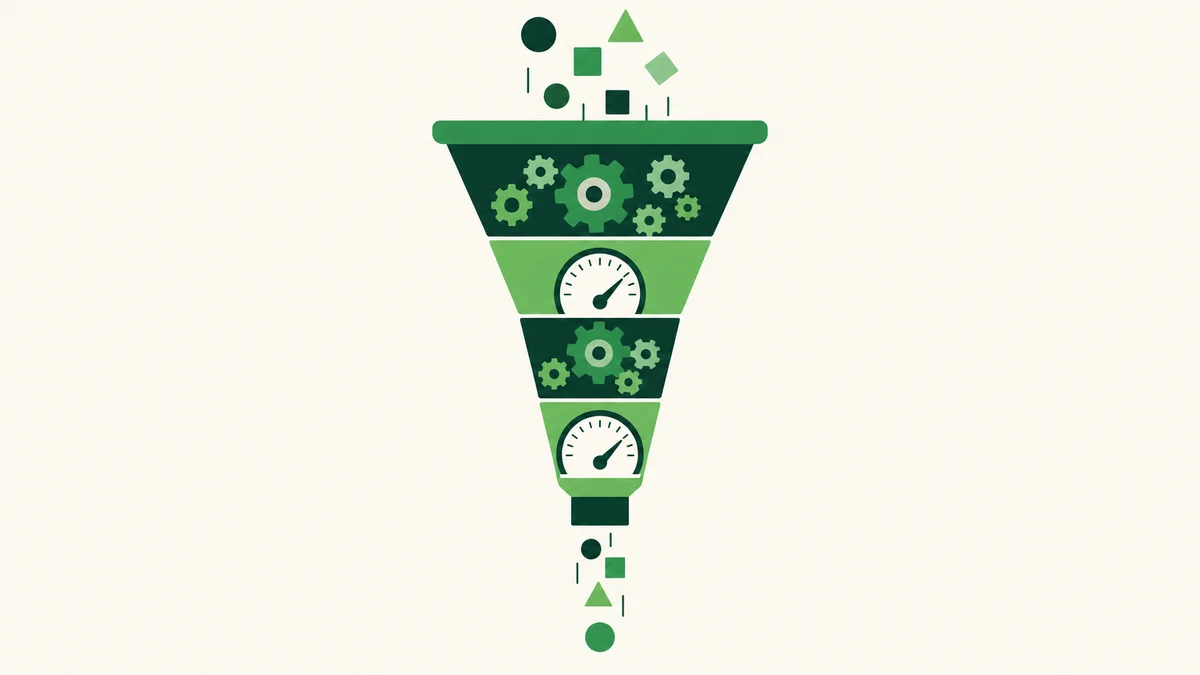
Flat illustration of a funnel with gear-shaped segments and hand-set dial segments
The pattern is consistent across the funnel. Work that follows a written rule can run unattended. Work that depends on a decision about what to count needs an owner first. The matrix below sorts each stage.
Leads assigned to the wrong rep or left unassigned
Qualification and scoring
Applies a score or threshold at scale
Written MQL and SQL criteria tied to buyer actions
Scores that reward activity instead of intent
Alerts and deal risk
Detects stalled deals, triggers notifications
Thresholds, owners, response expectations
Insight with no action; alerts nobody owns
Attribution
Stitches touchpoints, supports analysis
The model itself, the self-reported field, click ID storage
Credit assigned by default settings
Forecasting
Scores deals, prepares the roll-up
Commit criteria, override rules, accuracy review
A number nobody can defend
Reporting
Builds and schedules reports
One set of stage definitions both teams accept
Three labels help here. Unattended means the task follows a rule and can be reversed. Approved means an agent proposes and a person confirms. Set up first means a human must decide something before the platform can act at all. A closer look at dashboards is in this guide to a RevOps reporting dashboard.
What is the difference between an AI assistant and an AI agent in RevOps?
An AI assistant is software that surfaces insights or drafts content when a person asks, while an AI agent is software that takes actions in connected systems, such as updating CRM records or sending outreach, with limited human input. The difference matters in RevOps because agents write to the pipeline data that every report and forecast depends on.
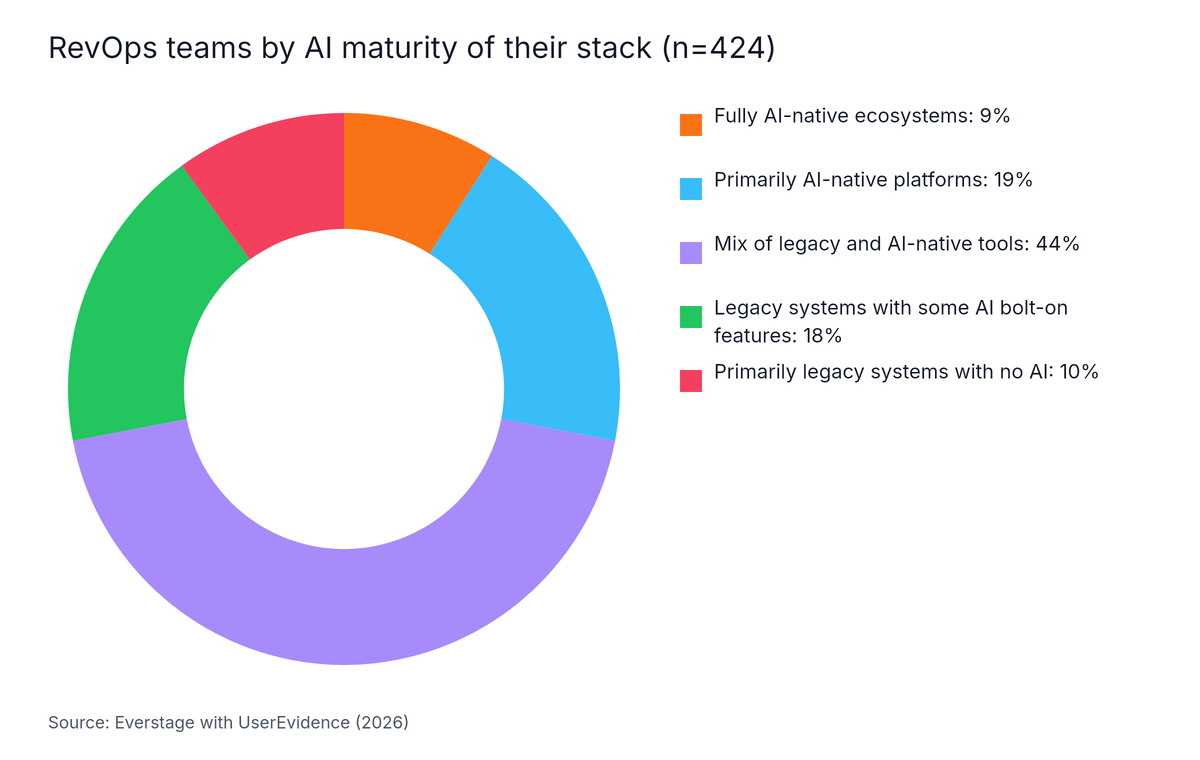
Donut chart: RevOps teams by AI maturity of their stack (n=424). Highest: Mix of legacy and AI-native tools at 44%.
Most teams are still early. In a survey of 424 senior RevOps professionals, 9% described their stack as fully AI-native, and 44% ran a mix of legacy and AI-native tools (Everstage with UserEvidence, 2026). Much of that adoption is assistant-style. A separate 2026 survey found 51% of senior revenue leaders said AI's biggest shortcoming is that it surfaces an insight without acting on it (Everstage, 2026).
An Everstage executive put the limit this way: "The AI scores the deals and summarizes the calls, and then it stops." (Everstage via Business Wire, 2026)
Where comfort with autonomy ends
PwC's 2026 operations survey found 57% of respondents comfortable with AI agents detecting anomalies and triggering corrective actions, but only 37% with full end-to-end execution (PwC, 2026). That split matches the funnel: detection and alerts automate, while end-to-end ownership of a decision does not.
Does AI lead routing work if CRM data is messy?
AI lead routing works only as well as the fields it reads. When owner, territory, account and lifecycle stage fields are incomplete or duplicated, routing rules misassign leads and agents act on the wrong records. LeanData's 2026 survey of 157 B2B revenue leaders found 55% name data quality as their top AI challenge (LeanData, 2026).
Flat illustration of an AI assistant versus an agent as two connected modules
The same survey found 70% of respondents saw data hygiene and quality issues degrade go-to-market execution, including actions taken by agents (LeanData, 2026). A further 27% had multiple tools or agents send outreach to the same prospect, a routing and orchestration failure (LeanData, 2026). Both figures come from a vendor-sponsored survey of enterprise B2B companies, so treat them as directional.
What messy data looks like to a routing rule
A routing rule is a yes or no test on a field. If "employee count" is blank, a segment rule cannot fire. If one company exists as three accounts, three agents may contact it. If lead source holds forty spellings, reports cannot group it. Better matching logic does not fix any of these; cleaning the fields does.
How ready is revenue data?
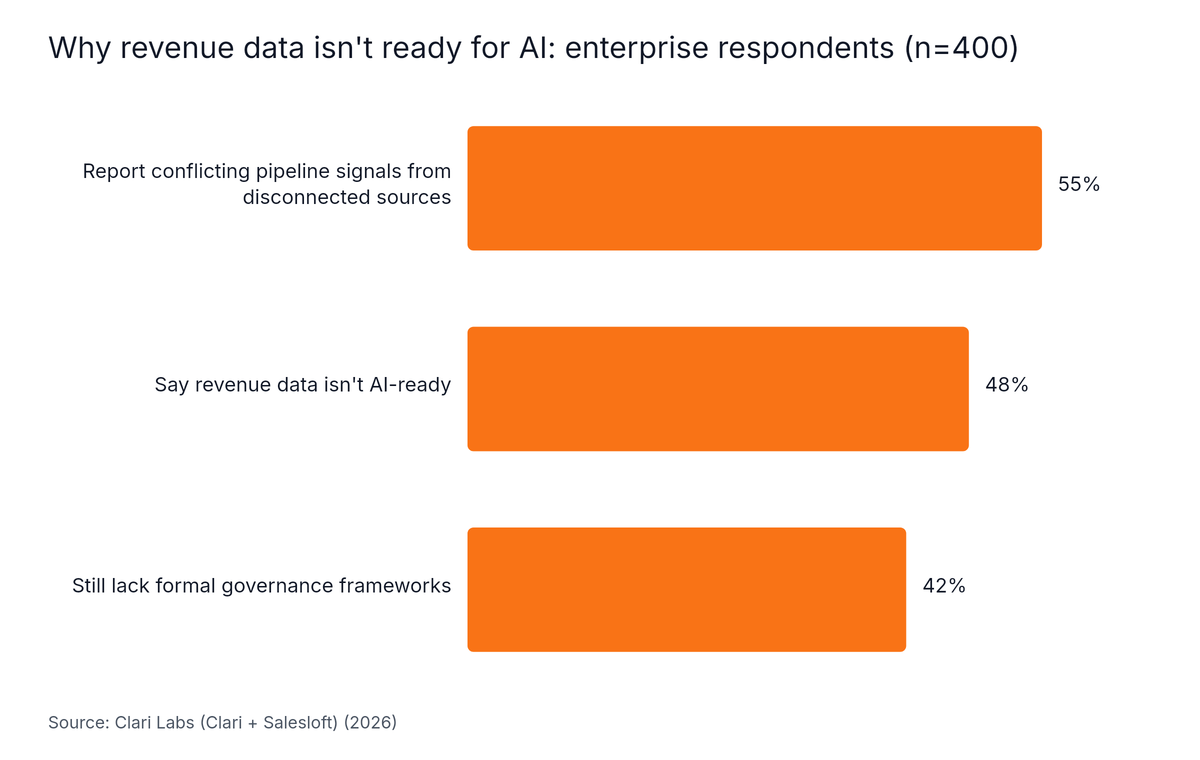
Clari Labs surveyed 400 CIOs, CROs and RevOps leaders at North American enterprises with 1,000+ employees. It found 48% say their revenue data is not AI-ready, and 55% report conflicting pipeline signals from disconnected data sources (Clari Labs, 2026). Another 42% still lack formal governance frameworks.
Horizontal Bar chart: Why revenue data isn't ready for AI: enterprise respondents (n=400). Highest: Report conflicting pipeline signals from disconnected sources at 55%.
One more number frames the problem. In a 2026 survey of 300+ RevOps leaders, 19% named poor data quality as the number-one barrier to AI adoption, and 18% named a lack of internal knowledge on how to implement AI (Default, 2026). Skills and data are both gating factors.
Finding
Share
Source (year)
Name data quality as top AI challenge
55%
LeanData (2026)
Saw data issues degrade GTM execution
70%
LeanData (2026)
Multiple agents contacted the same prospect
27%
LeanData (2026)
Say revenue data is not AI-ready
48%
Clari Labs (2026)
Report conflicting pipeline signals
55%
Clari Labs (2026)
Who sets stage definitions, attribution models and forecast overrides?
A named RevOps owner sets all three, because AI can apply a definition but cannot decide what a business should count. A lifecycle stage is a named point in the buyer's path with a written entry criterion. Attribution model choice and forecast overrides follow the same rule: a person picks, documents and reviews them.
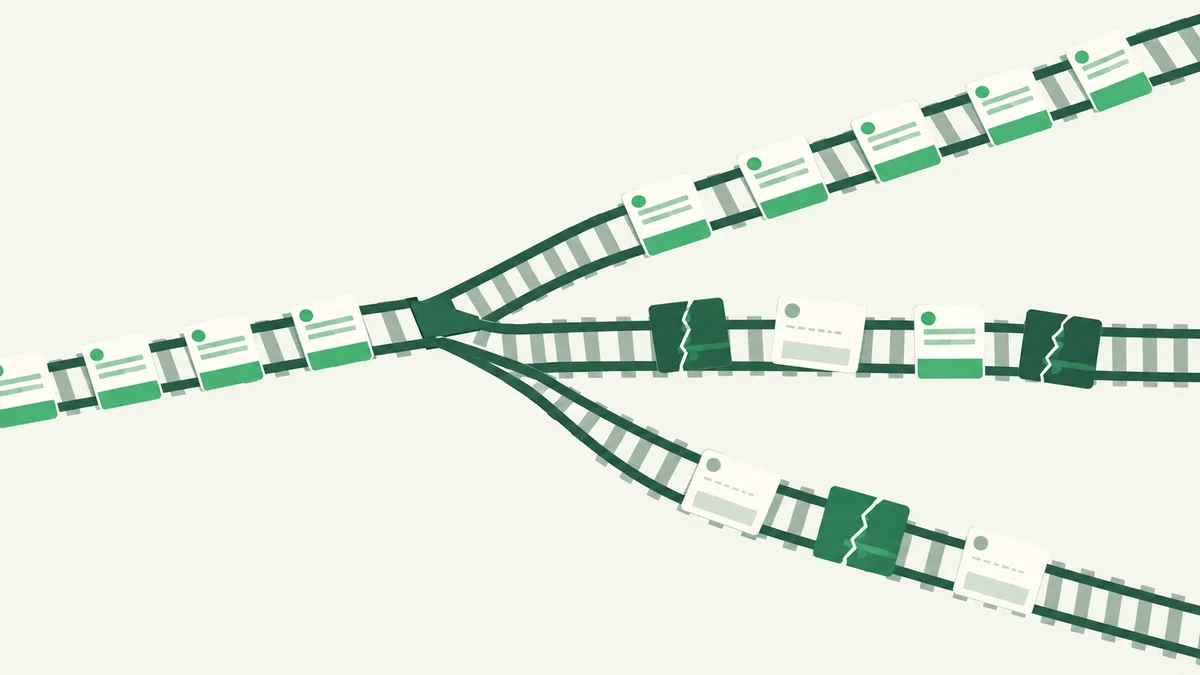
Flat illustration of a routing switch sending cards down tracks, some cards with a warning mark
Stage definitions
A lifecycle stage needs an entry criterion tied to a buyer action, not a seller's hunch. Without it, AI scoring optimizes for whatever the CRM currently calls a lead. The cost shows in practice. GrowthSpree's June 2026 audit of 104 Google Ads accounts ($78.0M in spend) found 78% of form fills never became a sales-qualified lead (SQL).
Our data: In GrowthSpree's June 2026 audit of 104 Google Ads accounts, 91% had no Google click ID (GCLID) reaching the CRM and 89% ran default attribution. After a 90-day attribution fix, the share of closed-won deals traced to a campaign went from 0% to 67%.
Conversion varies by definition. One benchmark across 50+ clients from First Page Sage (updated June 2025) gives marketing-qualified lead (MQL) to SQL rates of 26% for paid search, 30% for LinkedIn and 51% for SEO. A separate GrowthSpree benchmark (April 2026) gives a median of 13% to 18% for B2B SaaS Google Ads. The two define stages differently and should not be averaged.
Attribution model selection
Data-driven attribution is a model that assigns credit across touchpoints using observed conversion paths, and Google Ads uses it by default. A human still chooses how the CRM reports credit, which touches count and whether a "how did you hear about us" field sits beside the model. GrowthSpree's 2026 blog benchmarks on attribution accuracy, which state no method, rate single-model attribution at 38% to 58% accuracy and a hybrid of multi-touch, self-reported and branded search lift at 82% to 92%. Treat that as opinion, not a finding. For the options, see this guide to attribution models in B2B marketing.
Forecast overrides
A forecast override is a person's adjustment to the model's number. GrowthSpree's 2026 blog benchmarks on forecast accuracy, which state no sample or method, put median commit accuracy at 85%, best-case at 38% and weighted pipeline at 22%. Those are unsampled ranges, so read them as a prompt to measure your own. Buyers lean on people too: a 2026 Gartner survey of 645 B2B buyers found 69% prefer to validate AI-generated insights with sales reps (Gartner, 2026).
A workable override rule has four parts:
Bound the change to a stated range.
Require a reason code on every override.
Keep the model's original number beside the human number.
Review override accuracy each quarter.
What should be fixed before deploying AI agents in the CRM?
Five fixes come before any agent gets CRM write access: written stage definitions, clean account and contact relationships, standardized lead-source values, duplicate rules, and complete fields for territory routing. Clari Labs' 2026 research found 42% of enterprises still lack formal governance frameworks for the accuracy and control of revenue data (Clari Labs, 2026).
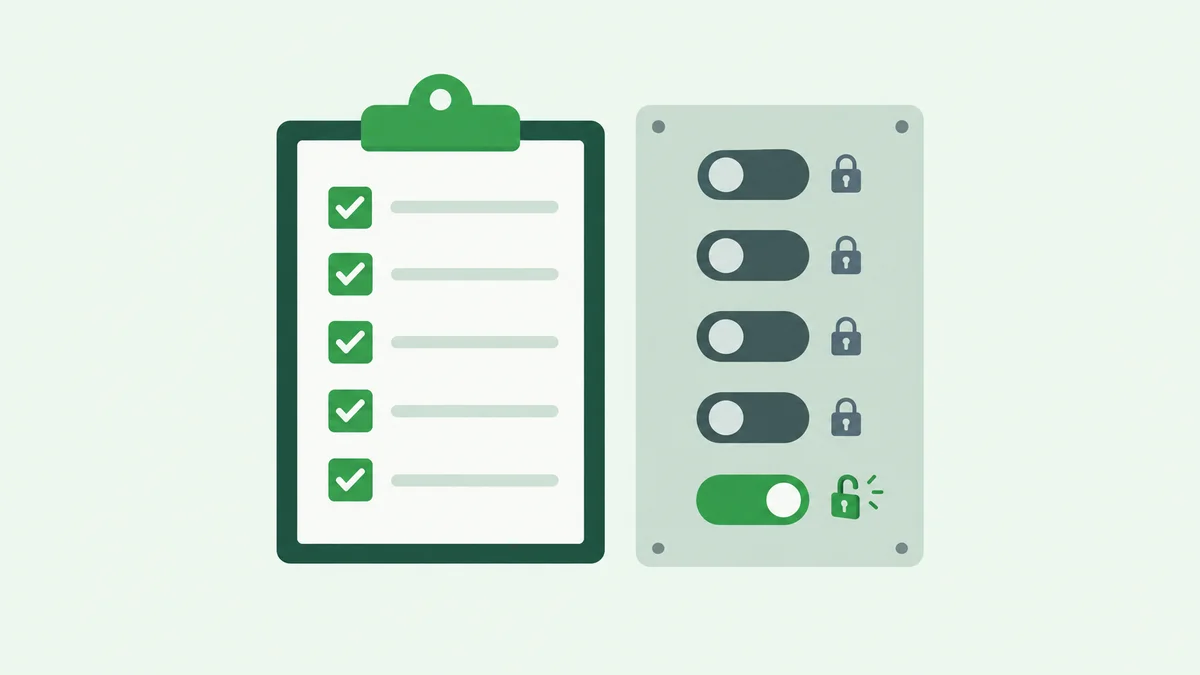
Flat illustration of a pre-flight checklist clipboard beside a control panel with locked and unlocked switches
Work through the checklist in order:
Write the stage model. Record each lifecycle stage with an entry criterion tied to a buyer action, and link it from every report.
Fix account and contact objects. Each contact belongs to one account, and each account appears once.
Standardize lead source. Use a fixed list of values plus a self-reported field.
Set duplicate rules. Merge or block duplicates at creation, before agents act on them.
Complete routing fields. Territory, segment and owner fields must be filled for every record a rule reads.
Limit write access. Give each agent its own identity, start read-only, and log what it reads and changes.
If a click ID is not stored with each lead, ad spend cannot be tied to revenue, and no AI layer fixes that later. Google also moved custom offline uploads to the Data Manager API from June 15, 2026, so check the upload method in use.
Questions on any of these steps are easiest to settle with someone who has seen the setup before. Meet with an expert for a free consultation and bring a funnel, CRM or reporting question.
How to check it worked
Check
Pass condition
Routing
Every inbound lead has an owner within the target window
Duplicates
No prospect receives touches from two agents or tools
Stage model
Marketing and sales report the same count for each stage
Alerts
Each alert has a named owner and a recorded action
Overrides
Original and overridden forecast numbers are both stored
Who is this approach not for?
The stage-by-stage mapping of AI-driven RevOps platforms does not fit teams with no sales team and no CRM yet, or buyers wanting a ranked vendor list. It assumes a B2B SaaS company with a working pipeline and a RevOps owner. Even among larger firms, McKinsey's 2025 State of AI found no more than 10% scaling AI agents in any single function (McKinsey, 2025).
Several limits apply to the evidence. Most survey figures here come from vendor-sponsored research, and their samples skew toward enterprise and North American companies. Independent benchmarks of AI forecast accuracy are scarce, so none are cited. Segment and regional specifics (the UK, Europe, India or verticals such as FinTech and DevTools) are not covered by the sources used. Consent rules for tracking in the European Economic Area, the UK and Switzerland also apply to any agent that touches lead data, and this page gives no legal advice.
Which parts of the revenue funnel can AI agents automate without human oversight?
AI agents can run rule-based, reversible work without oversight: lead routing against written rules, enrichment of missing fields, alert triggers and scheduled report generation. Work that changes definitions, attribution or the forecast should keep a human approver. PwC's 2026 survey found 57% comfortable with agents detecting anomalies and triggering corrective actions, but only 37% with full end-to-end execution (PwC, 2026).
Can AI replace manual forecast calls and overrides in RevOps?
AI cannot replace forecast overrides, because an override is a human judgment about information the model may not hold. AI can score deals, flag risk and prepare the forecast. A RevOps owner should keep the model's original number beside any override, require a reason code and review override accuracy each quarter.
Why do AI sales tools send duplicate outreach to the same prospect?
AI sales tools send duplicate outreach when several tools or agents act on the same prospect without shared routing or suppression rules. LeanData's 2026 survey of 157 B2B revenue leaders found 27% had multiple tools or agents contact the same prospect (LeanData, 2026). Gartner also warns of agent sprawl, predicting that by 2028 AI agents will outnumber sellers 10 to 1 (Gartner, 2026). A single owner field and one orchestration rule prevent most duplicates.
How do I audit what an AI agent changed in the CRM?
To audit an AI agent in a customer relationship management (CRM) system, log every field it reads and writes, tag its edits with a dedicated user or integration identity, and review the change history weekly. Limit write access until a RevOps owner can inspect what the agent saw and changed. Clari Labs' 2026 research found 42% of enterprises still lack formal data governance frameworks (Clari Labs, 2026).
What data should be cleaned before deploying AI agents in a CRM?
Before deploying AI agents in a CRM, clean lifecycle and stage definitions, account and contact relationships, lead-source values, duplicate records and the fields territory routing reads. Clari Labs' 2026 research found 48% of enterprises say their revenue data is not AI-ready (Clari Labs, 2026), so a short audit of these five areas pays off first.
Conclusion
AI-driven platforms speed up work that already follows a rule, and they stall where a decision about definitions, credit or judgment is missing. For a B2B SaaS team, the sequence is simple.
Automate routing, alert triggers and report generation first, once the fields behind them are clean.
Write stage definitions down before turning on AI scoring.
Choose and defend the attribution model; use AI to support the analysis.
Keep the model's forecast beside every human override.
Give agents their own identity and start them read-only.
The next step is to pick one stage, run the pre-flight checks above, and compare the result with the reporting dashboard both teams use. One funnel. One set of definitions. One number everyone trusts.
Written by
Ishan Manchanda
Ishan Manchanda is co-founder of GrowthSpree, a B2B SaaS marketing consultancy founded in 2017 that has managed $60M+ in ad spend across 300+ B2B SaaS companies. He focuses on demand generation, go-to-market strategy and pipeline growth, and has been featured in Silicon Valley Times, SaaS Mag and the Unbounce podcast.
 Ishan ManchandaNov 23, 2026